Earlier this year, Simpson County Judge-Executive Mason Barnes blocked me from his official county Judge-Executive social media page after the Barren River Area Development District (BRADD) ethics board found he had violated the Simpson County ethics code due to a complaint that I and other concerned residents submitted to the board.
I filed the complaint against Barnes because I wanted to ensure he was aware of his obligations as a public official to follow the local code of ethics. I didn’t seek to attack him, but to defend Simpson County residents against abuses of power.
However, soon after the ethics board released their decision finding Barnes guilty of these ethics violations, I was informed by a neighbor that he had posted a rant on his CJE Facebook page, naming me and others who had signed the complaint.
When I tried to view the post, I found that I had been blocked. Instead of engaging in honest and transparent discussion, this public official would apparently rather silence and shame those who held him accountable.
Through the assistance of the Liberty Justice Center, a non-profit and non-partisan public interest law firm that fiercely advocates for First Amendment rights, I sued Barnes for violating my constitutional rights.
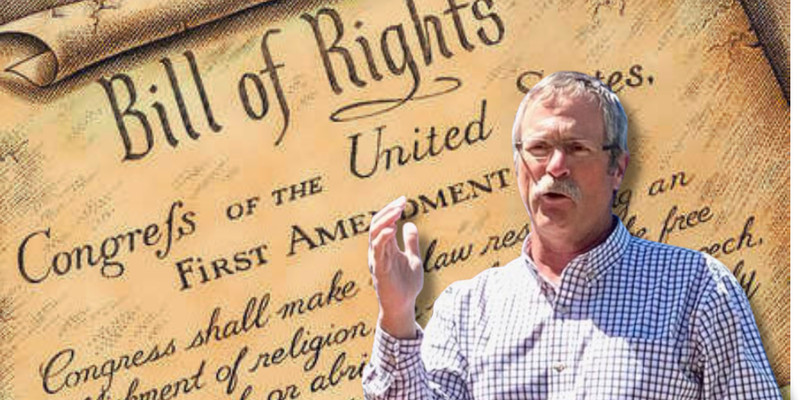
I sued because I wanted Barnes to understand that the First Amendment allows all citizens to have a robust public discourse and prevents officials like him from engaging in viewpoint discrimination, even when the discussion on his Judge-Executive Facebook page pertains to topics that he does not agree with. Every resident of Simpson County should be able to express their political opinion on Barnes’ Judge-Executive Facebook page—particularly because it is used to share important community matters.
Barnes frequently hosts Facebook Live videos on his official Facebook page where he has moderated discussion about important community matters. Because he blocked me, I and others who he blocked had no access to view or comment on these county updates. In addition to silencing my free speech, Barnes’ Facebook block withheld information from citizens that Barnes disliked and whose views he disagreed with.
This behavior was unacceptable.
In a free society, citizens’ voices should not be silenced by self-serving bureaucrats who are upset that discussions on their social media that may not align with their political agenda. And, this isn’t just a lesson for Mr. Barnes – it’s a lesson for publicly elected officials across the country and at all levels of government. A 2024 Supreme Court ruling, Lindke v. Freed, clearly established that public officials, such as Barnes, may not discriminate against their constituents by silencing critics on their official government social media pages.
Four months later, I am glad to announce that my lawsuit is settled. Thanks to the tireless efforts of my attorneys at the Liberty Justice Center, Barnes has unblocked me and committed to never silence me on social media again. My hope is that he now realizes there are some important First Amendment rules that he is required to follow due to his role as a public official.
In fact, this is not the only First Amendment victory that Liberty Justice Center has secured in Kentucky. Earlier this year, they won a case against Pulaski County Schools. The school system blocked a school choice advocate who commented on its social media page–due to LJC’s efforts, their client is unblocked and the school has agreed to provide First Amendment training to its communications staff.
In the future, I encourage Barnes and the Simpson County magistrates – along with elected officials and policymakers across the country – to host community town halls in person, and not via Barnes’ social media page, and in the evening, not during the working hours, when regular Fiscal Court meetings usually occur. In my community, there have been many recent important community events such as the reorganization of the local Planning and Zoning Board, Industrial Authority matters, and other issues where residents like me have been blocked from seeing Barnes’ updates. And, this is happening across the country.
We need leaders in communities who are not afraid to have conversations with residents such as me, even if they are difficult conversations and even if they require the extra effort of hosting additional meetings. We need leaders who are transparent with all of their citizens about matters in the community. What we don’t need is leaders who attempt to silence anyone who holds them accountable to the people they serve.
An in-person public forum gives everyone a chance to be informed, ask questions, and provide more accountability to public officials such as Barnes who must follow Kentucky Open Meetings Laws and has a history of hiding behind social media posts instead of addressing his constituents in person. And, similar laws exist in communities and states across the country.
This victory should be a warning to any public official who tries to silence their constituents. It should also be an encouragement to others who have been silenced by their local government—and who should direct their public officials to these recent Liberty Justice Center case examples. This should put them on notice that the First Amendment is a powerful right that allows for free expression of their constituents, even when they don’t like it.
Joel Peyton is a Kentucky whistleblower, whose speech online was censored after he exposed unethical behavior in his local government in the Peyton v. Barnes case.