
In the wake of Charlie Kirk's murder, three distinct narratives have taken form to explain the killing and other instances of spectacular, apparently political violence in America—assassinations and attempted assassinations, school shootings, church shootings. I say "apparently" to maintain a sense of even-handedness for the moment. It will become clear what I believe soon enough, if you didn't already know or couldn't guess.
First, there's the right-wing narrative. It goes something like this. These attacks are all or mostly instances of radical left-wing violence, intended to terrorise, demoralise, and ultimately defeat the American right and usher in a leftist takeover.
Radical leftist groups often coordinate and encourage this violence, and they're given money by very powerful people like George Soros and his Open Society Foundations, but in fact, the entire culture is geared towards coordinating and encouraging it. Social-media influencers like Destiny and Hasan Piker regularly call for the streets to run red with the blood of "capitalists" and Trump supporters. The mainstream media encourages leftist violence. Hollywood, television, and music encourage it. Politicians do too.
Just last week, Gavin Newsom signed into law a bill to make it illegal for federal agents, including ICE agents, to wear masks in California. The aim, obviously, is to threaten ICE agents and make them feel unsafe. If they can't hide their identities as they carry out raids in sanctuary jurisdictions and areas where opposition is fierce, they may be subject to doxxing—to having their names and addresses revealed—and face intimidation and revenge attacks. Perhaps this will make them think twice about the job they're doing. Newsom has referred to ICE operations as part of an "authoritarian government."
On Wednesday, there was a fatal attack on an ICE facility in Dallas. However, the victims were not ICE agents but migrants, apparently killed by mistake when a gunman shot through the windows of an ICE vehicle. At an event in North Carolina, Vice President JD Vance slammed Governor Newsom for his part in "encouraging crazy people to go and commit violence." Newsom hit back and said he was doing nothing of the sort.
Second, there's the leftist narrative, or what I call the BlueAnon or bluetard spin. This focuses on apparent ambiguities and oddities, like the multiple meanings of some of the inscriptions on bullets recovered at the scene of Charlie Kirk's murder, to flip the right-wing story on its head: Charlie Kirk's murder was actually carried out by a "far-right extremist," probably a "Groyper" (i.e., a fan of Nick Fuentes), who thought Kirk was a sellout, a "cuck," a barrier to the kind of "based world," replete with "right-wing death squads," that they want to see. The fewer moderating influences that remain on the right, the better. And, of course, the murder of a prominent right-wing figure who made dialogue across the political divide his central mission will only convince more people on the right that dialogue with the other side simply isn't possible, especially if the murder is "wrongly" blamed on the left. Right-wingers are actually the ones who commit the majority of political violence in America.
This is the kind of bilge that continues to flow, without interruption, from the mouth and fingertips of people like Keith Olbermann, but it's also been repeated widely in the mainstream media, in print and on screen.
In large part, this narrative serves to muddy the waters and distract from the real nature of the problem. Its proponents have been widely successful in doing so, certainly on their own side. Polling has shown that, among Democrats at least, only a small minority believes Charlie Kirk's killer was a leftist—something like 10%. More—around a third—believe he was a Republican. The same goes for independent voters. Even a small segment of Republicans believes Tyler Robinson was one of their own.
The third narrative has taken shape more gradually and less noisily than the bluetard narrative, but it's no less sinister or dangerous as a result. In fact, it may be more so, because it wears the garb of neutrality and reasonableness, when in fact it's neither of those things. It's not neutral. It's partisan. It serves the interests of one side at the expense of the other, and it needs to be rejected.
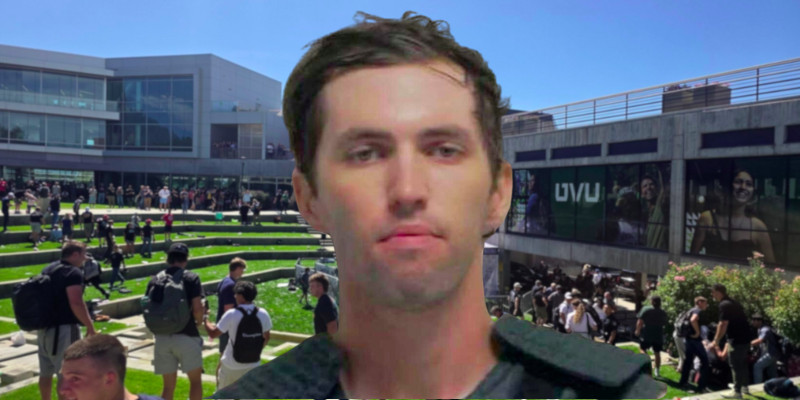
This is a narrative that says Charlie Kirk's killer was simply a misfit, a weirdo who was so alienated and mixed up in internet culture that he thought killing the Turning Point USA founder in public with a hunting rifle would be cool and funny, but not a coherent political action or statement that makes sense as part of a broader ideology or movement.
This is "radical normie terrorism," as Christopher Rufo, who has emerged as an unlikely champion of the theory, has dubbed it. Let's take a closer look at what Rufo has to say on the subject.
Radical normie terrorism has nothing to do with leftist liberation or right-wing acceleration. Instead, it's about the nihilism of modern culture, the sickness at the heart of our society, lost boys who dress up in anthropomorphic fox suits and spend all their time playing video games, jerking off to porn, and browsing edgy forums like 4Chan. These people are "perpetually online," Rufo says, and as a result, they lose track of what's real and what's not. And then they kill.
Rufo contrasts these young men with the radicals of the 1960s and 1970s, who "hijacked airplanes, set bombs in government buildings, and assassinated police officers in service of political goals." These radicals of yesteryear, profiled in the fantastic book Days of Rage, were real radicals. They were "radical but largely lucid, justifying their actions with appeals to a larger cause."
Radical normie terrorists like Tyler Robinson, on the other hand, have no ideology, are part of no organisation, and have no "concrete political aim." They may be radical, but that's it.
The source of their radicalism is not Karl Marx, Franz Fanon, or even Ibram X. Kendi, but a "particular kind of psychopathology." As well as Tyler Robinson, Rufo uses the example of Robin Westman, who shot up Annunciation Catholic Church in Minneapolis and killed two children. Westman, who was transgender, left behind a diary in which he described lurid fantasies of killing children. He said he was a demon and drew images of himself as that demon, looking at himself in the mirror. Although he adorned his weapons with political slogans, including "Kill Donald Trump," these were memes and ironies, designed to give the appearance of ideology." "The ideology was a brittle shell around a deeper emptiness that could only be satisfied with horror," Rufo adds.
Robinson had a transgender boyfriend. Like Westman, he was also "terminally online." He "spent thousands of hours playing video games, had an account on sexual fetish websites, and played a 'dating simulator' game involving 'furries,' muscular cartoon characters that are half-animal and half-man." The slogans he wrote on the bullet casings found at the scene of Charlie Kirk's murder were a mish-mash of leftist slogans and internet memes: "Hey fascist! CATCH." But also: "If you read this, you are GAY Lmao." And: "Notices bulge OwO what's this?"—a reference to a disgusting furry meme.
What makes their crimes all the more shocking, Rufo says, is that Robinson and Westman both came from "functional households": "ordinary, middle-class, middle American families."
Robinson and Westman were killed, but only in the service of "gratifying an obscure personal urge." They "did not seek to change policy or dismantle a system of government." Their acts of terror, Rufo concludes, were not political. Instead, they "reflect something dark in our nation's soul." Something has gone terribly wrong, and we all bear responsibility for it, at some level.
Rufo warns that these radical normie terrorists present a serious threat, perhaps a uniquely serious threat, because law enforcement is poorly equipped to deal with them. The FBI relies on traditional methods for tracking dangerous individuals and groups—including tips, door-knocking, and interviews—and these almost always fail to identify people like Robinson and Westman before it's too late.
Even so, something has to be done to stop them. Rufo gestures towards policing the internet and suggests there needs to be some kind of "reform" of the wider "culture," although he doesn't say what that might be. Instead, he ends his essay with an exhortation that's vague but also intended to be emotionally satisfying.
"We should keep the stakes in mind as we work to protect the things we love and grapple for a solution, as elusive as it may seem."
I've laid out Rufo's analysis from start to finish, because I think it's worth seeing it in full. The analysis has its merits. I'd be the last person to deny, for example, that somebody like Tyler Robinson is different in important ways from Bernardine Dohrn, one of the leaders of the Weather Underground in the 1970s, or Assata Shakur, who was a member of the Black Liberation Army. I'd also be the last to deny that men like Robinson and Robin Westman do exhibit a "particular kind of psychopathology" and that their anger, resentment, and murderousness are nursed by isolation, video games, the internet, and other freaks who share their delusions—including the delusion they were born in the wrong body. The forces that shape this psychopathology largely didn't exist in the 1960s and 1970s.
But how different are these new radicals from the old? How different really?
At first sight, organisation does appear to be a big difference between then and now. Yes, radical normie terrorism—I'm going to stop using that label in a moment—is more decentralised. Tyler Robinson was not working as part of an identifiable grouping with a definite membership, a name, and some kind of governing body or committee that issues communiqués and manifestos, like the Weather Underground. We don't yet know, however, whether he really was a lone wolf or whether he had help. Early evidence suggests he did not work alone. We do know, at least, that he planned the attack.
The Weather Underground and other groups were part of a broader movement that we could call "the Counterculture" or "the protest movement" if we liked, and they all shared broad goals—"liberation," the overthrow of the West's oppressive structures (capitalism, imperialism, patriarchy)—but these groups weren't anywhere near as coherent or functional as Rufo makes out. This point is clear from a proper reading of Days of Rage. Different factions were constantly vying for control of the Weather Underground and the Black Liberation Army, and there was constant infighting and schisms, often violent schisms. Ideology and organisation were always disputed and in question, to some extent. Nor did these groups work together with each other. For the most part, they were isolated and worked individually to achieve their shifting goals.
If today's terror, as represented by the Tyler Robinsons and the Robin Westmans, is more decentralised, that's because it can afford to be, for one simple reason: The radicals of the 1960s and 1970s won. They got what they were fighting for. Their anti-capitalist, anti-colonial, anti-racist, anti-patriarchal ideas are now the water in which we, the fish of the 2020s, swim. The left won the culture war. They completed the long march through the institutions—the schools, the colleges and universities, the corporations, the public sector, government, even the military—a fact that was underscored by the sickening public response to Charlie Kirk's murder. It wasn't just schoolteachers or university students and faculty who were gloating, but Secret Service members, FEMA employees, and military personnel. A full colonel is under investigation for a social-media post.
There doesn't need to be an obvious command structure for the left in 2020. The goals of leftist subversion and revolution are basic and understood. It's that simple. We imbibe the values of the Weather Underground and the Black Liberation Army from the beginning of our lives now, in books like Anti-Racist Baby and Bye Bye Binary—both real books for infants. The radical left is the culture. Its values are default.
If there are no determinate politics behind the actions of Tyler Robinson and Robin Westman and others like them, as Christopher Rufo wants us to believe, ask yourself: Why are their targets always leftist targets? Why did Tyler Robinson choose Charlie Kirk and not Harry Sisson, Jen Psaki, or Mark Ruffalo to murder? Why did Robin Westman choose the Catholic Church and not the Church of Satan, a Reddit convention, or an LGBTQI+ pride parade to attack? As I reported for Infowars a few weeks ago, over 500 churches have been attacked in the US since May 2020, with the vast majority of attacks coming after the leaking of the Dobbs decision in 2022, which overturned Roe v. Wade.
Leftists celebrate the murder of Charlie Kirk because it was, sadly, a decisive blow against their enemies. Charlie Kirk was one of the brightest stars of the American right—intelligent, presentable, relatable, charismatic, and brave—and he created a massive youth movement, Turning Point USA, that helped secure a historic return to power for Donald Trump. That movement looked set to guarantee the future for the new Republican party, but now that future looks anything but guaranteed. The right will not find an easy replacement for Charlie Kirk.
Leftists celebrate attacks on Christian churches and Christian figures because Christianity, at least in its proper form, is its enemy too, a protector and guarantor of institutions like the family that the left has always wanted to destroy.
We also shouldn't think that terror, in itself, isn't a concrete political aim. It is. Since Charlie Kirk's murder, right-wingers are now thinking twice about whether to hold rallies or in-person events, scaling back their plans and beefing up their security. Celebrities who endorsed Donald Trump during the election or gave him a platform, like podcaster Theo Von, are now distancing themselves from him. They don't want the next Tyler Robinson to come for them. And, of course, there will be another Tyler Robinson. This is what terror achieves.
There are other serious problems with Rufo's theory that I won't dwell on at length. The "normie" part, for example. What's normal about being a furry with a transgender boyfriend? Tyler Robinson is not normal, and neither was Robin Westman. If anybody was a normie, it was actually people like Bernardine Dohrn and countless other radicals of the '60s and '70s. These people really were normal and looked set for middle-class, respectable lives until they saw the light and became committed to the overthrow of the US government.
Dohrn grew up in Whitefish Bay, an upper-middle-class suburb of Milwaukee, the daughter of a Jewish father and a Christian Scientist mother. At school, she was a cheerleader, treasurer of the Modern Dance Club, a member of the National Honor Society, and editor of the school newspaper. She did a political science degree at the University of Chicago and then went to law school. All of this information is on Wikipedia. The Weather Underground grew out of a student movement, full of people just like Bernardine Dohrn.
Psychopathology: Again, where's the difference? We shouldn't let apparent differences in organisation and "coherence" blind us to the fact that the radicals of the 1960s and 1970s were psychopaths too, and their actions were grounded in emotions like anger, hatred, and resentment. They did brutal shit, and what's more, they revelled in it. Here, I'll let a description of a double murder from Days of Rage do the talking for me.
It's 1971, and two members of the Black Liberation Army—a self-proclaimed "army of angry niggas"—are out looking for police to kill on the west side of the Harlem River, New York. They find two police officers in Colonial Park, and this is what happens.
"Officer Jones, who was black, was struck three times, first in the back of the head, then twice in the spine. He died instantly. The second gunman fired repeatedly into Officer Piagentini, who fell to the sidewalk but, as the gunman cursed him, refused to die. The first gunman then reached down and removed Officer Jones's .38, hefting it in his hand, feeling its weight, as if he were taking a souvenir. The second gunman wrenched Piagentini's weapon from its holster even as the dying officer flailed at him. Once he had it, he fired every bullet in its chamber into the fallen cop.
Still, Piagentini wouldn't die. The first gunman stepped to his prone body, pointed his .45 downward, and fired a single shot. Then both shooters turned and walked away. Behind them, Officer Piagentini, in his last moments of life, began crawling toward the safety of a green hedge, a trail of blood in his wake. The next morning, the coroner would count twenty-two bullet holes in his body."
It's easy to understand why leftists are pushing this third narrative about violence being done by their own people. Matthew Walther, a writer for The Lamp, made a very similar argument to Christopher Rufo's in a New York Times opinion piece a week ago. At the end of the piece, he states, quite clearly, that accepting this third narrative is about preventing the right from taking "reprisals" against the left, which, of course, is what the right—and I mean the Trump administration—should be doing at this very moment, especially since the President has now designated Antifa a terrorist organisation.
Walther also sprang a nasty trap, a sting in the tail, blaming Charlie Kirk himself and right-wingers, in effect, for creating Tyler Robinson. Kirk's own work with Turning Point USA was "decontextualized," disseminated through short TikTok videos, just like the memes that supposedly radicalised his killer. The right-wing clamour to make sense of the killing online was also part of the "same debased form of communication" that's robbed politics of its meaning and helped to create a "fantasy world" where nihilistic murder for LOLs takes the place of genuine political action. Charlie Kirk and his supporters are as much to blame as anyone else.
"The calls for political reprisals by many on the right…are further contributions to this ersatz online reality," Walther says, "with its indifference to truth and its algorithmic dominion over our imaginations and attention spans, threatening our capacities to reflect and to see with eyes unclouded."
The big question is why someone like Christopher Rufo, who has spent years fighting the radical left on its own turf, in the schools and universities, and who knows what its programme looks like, would throw his name behind this insidious attempt to deny the reality of leftist violence.
Why would he seek to deprive of meaning and purpose acts whose meaning and purpose he, of all people, ought to know? Really.