
Flags have become the latest sore spot in England's struggle over identity and its cultural errosion thanks in part to mass immigration. In Birmingham, Worcester, Bradford, and other cities, rows of Union Jacks and St. George’s crosses are being pulled from lampposts and painted across roundabouts under a movement dubbed Operation Raise the Colours, the BBC reports.
Supporters, the outlet says, believe it is a display of patriotism, though others say it is a direct response to another trend: the highly visible, and increasingly controversial, wave of Pakistani flags and Independence Day celebrations that have filled Britain’s streets every August, when Pakistan obtained it's independence from the British Raj in 1947.
Councils and community groups have permitted Pakistani flags to be raised in public squares, or flown freely during processions that shut down major streets. Local English residents, concerned at what they see as the erosion or replacement of their own culture, have taken matters into their own hands, decorating neighborhoods with the symbols of England and the Union.
Authorities do not seem to have any game plan for what's unfolding. Birmingham, a city that had 60,000 native born Pakistanis in its 2021 census, initially warned against attaching flags to streetlights on safety grounds, says the BBC.
Police forces in the Midlands and Worcestershire have even launched investigations into St. George’s crosses painted on traffic islands, labeling the acts “criminal damage.” Yet the same councils and police have appeared reluctant to intervene when Pakistani flags dominate public squares.
The dispute cant be separated from demographic reality. Britain’s Pakistani population has soared from around 10,000 in 1951 to more than 1.6 million by 2021, the largest Pakistani community in Europe. Unrelenting immigration waves, high fertility rates, and chain migration from Azad Kashmir and Punjab have turned once-small enclaves into dominant fixture. In towns like Bradford and Luton, Pakistani and Muslim populations now outnumber or rival the native English majority, with cultural and political life reflecting those shifts.
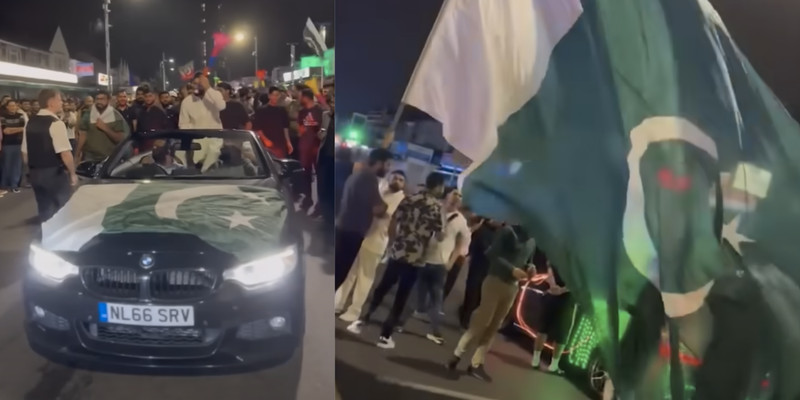
Independence Day parades, often involving thousands waving green flags and blasting music through city streets, are called harmless. Reuters and other outlets have downplayed criticism, labeling viral videos of flag-raisings “misleading” and insisting they are no different than routine consulate ceremonies. For many Britons, the optics are undeniable: while English flags are torn down from lampposts, Pakistani flags are waved from cars and rooftops in broad daylight with official sanction.
The flag wars are part a broader unease that is taking place in the UK. What began decades ago as supposed labor migration to address some shortages has transformed into a permanent demographic mainstay. Third and fourth-generation Pakistanis are now deeply embedded in Britain, forming one of the youngest and fastest-growing communities in the country.
These factors are all likely contributors to the rise of the country's newest political force, the Reform Party. Under leader Nigel Farage, the once fringe party has made huge strides, even being considered the most trustworthy to deal with immigration, according to polls.
Supporters, the outlet says, believe it is a display of patriotism, though others say it is a direct response to another trend: the highly visible, and increasingly controversial, wave of Pakistani flags and Independence Day celebrations that have filled Britain’s streets every August, when Pakistan obtained it's independence from the British Raj in 1947.
Councils and community groups have permitted Pakistani flags to be raised in public squares, or flown freely during processions that shut down major streets. Local English residents, concerned at what they see as the erosion or replacement of their own culture, have taken matters into their own hands, decorating neighborhoods with the symbols of England and the Union.
Authorities do not seem to have any game plan for what's unfolding. Birmingham, a city that had 60,000 native born Pakistanis in its 2021 census, initially warned against attaching flags to streetlights on safety grounds, says the BBC.
Police forces in the Midlands and Worcestershire have even launched investigations into St. George’s crosses painted on traffic islands, labeling the acts “criminal damage.” Yet the same councils and police have appeared reluctant to intervene when Pakistani flags dominate public squares.
The dispute cant be separated from demographic reality. Britain’s Pakistani population has soared from around 10,000 in 1951 to more than 1.6 million by 2021, the largest Pakistani community in Europe. Unrelenting immigration waves, high fertility rates, and chain migration from Azad Kashmir and Punjab have turned once-small enclaves into dominant fixture. In towns like Bradford and Luton, Pakistani and Muslim populations now outnumber or rival the native English majority, with cultural and political life reflecting those shifts.
Independence Day parades, often involving thousands waving green flags and blasting music through city streets, are called harmless. Reuters and other outlets have downplayed criticism, labeling viral videos of flag-raisings “misleading” and insisting they are no different than routine consulate ceremonies. For many Britons, the optics are undeniable: while English flags are torn down from lampposts, Pakistani flags are waved from cars and rooftops in broad daylight with official sanction.
The flag wars are part a broader unease that is taking place in the UK. What began decades ago as supposed labor migration to address some shortages has transformed into a permanent demographic mainstay. Third and fourth-generation Pakistanis are now deeply embedded in Britain, forming one of the youngest and fastest-growing communities in the country.
These factors are all likely contributors to the rise of the country's newest political force, the Reform Party. Under leader Nigel Farage, the once fringe party has made huge strides, even being considered the most trustworthy to deal with immigration, according to polls.