SOAD TABRIZI: Trump's plan to combat homelessness is a good start—but woke psychiatry needs to be overhauled
The mental health field isn’t just biased—it’s ideologically captured.
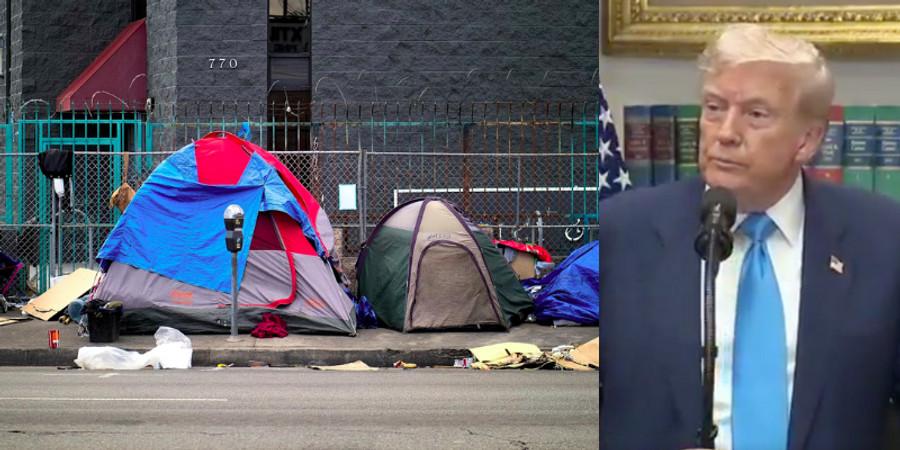
President Trump’s recent Executive Order, Ending Crime and Disorder on America’s Streets, is the strongest federal push we’ve seen to reclaim our public spaces from chaos, addiction, and mental illness. The directive restores order by cutting funding for “harm reduction” programs, encouraging civil commitment for individuals unable or unwilling to care for themselves, and prioritizing treatment over coddling.
But unless we first reform the psychiatric industry from top to bottom, this policy will be undermined by the very professionals tasked with implementing it.
Psychiatry, as it stands today, is not a science-led discipline. The Diagnostic and Statistical Manual of Mental Disorders (DSM)—psychiatry’s so-called bible—is not based on biomarker research or complex neuroscience. It’s a book of committee-voted categories, often shaped by ideology and influenced by pharmaceutical money.
In 2006, a peer-reviewed study published in Psychotherapy and Psychosomatics found that 56% of panel members responsible for the DSM-IV had financial ties to the pharmaceutical industry–including consultancies, research grants, and stock ownership (Cosgrove et al., 2006). That’s not a fringe conspiracy; it’s a documented fact. And it’s the foundation upon which modern psychiatric diagnosis is built. It’s no surprise, then, that new disorders continue to be added–often based on subjective behavioral patterns rather than objective biological evidence.
Take Disruptive Mood Dysregulation Disorder and Binge Eating Disorder – both introduced in DSM-5. These were added not because of a breakthrough in understanding brain function, but because committees decided certain behaviors were worthy of a label. No biomarkers. No lab tests. No definitive cause. Just a room of people deciding what counts as pathology.
And yet these diagnoses are used to determine access to care, insurance eligibility, and—now under this EO—involuntary institutionalization. That should alarm everyone.
Here’s what reform must start with: the ability to distinguish between actual mental illness and behavioral dysfunction.
There is a clear difference between someone with schizophrenia, whose condition is increasingly supported by neurological and structural brain research, and someone with a personality disorder, which is diagnosed through questionnaires and observable behavior alone.
Schizophrenia patients often lack insight, lose touch with reality, and are unable to care for themselves without medication or structured environments. In many cases, they do benefit from institutional support—not as punishment, but for the safety of themselves and society.
But someone with narcissistic or borderline traits who refuses therapy, refuses accountability, and weaponizes their diagnosis to avoid consequences? That’s not illness. That’s willful dysfunction.
This is the central question: Who determines whether someone needs treatment or incarceration? If that decision is left in the hands of the same ideologically driven professionals who created the DSM, we risk empowering an industry that is unaccountable, unscientific, and fundamentally political.
The mental health field isn’t just biased—it’s ideologically captured. One major study found that 94% of social and personality psychologists identify as liberal (Inbar & Lammers, 2012), creating a massive echo chamber that shapes how future clinicians are trained, how research is interpreted, and how dissenting worldviews are treated. When nearly every gatekeeper shares the same political lens, neutrality in diagnosis becomes a fantasy.
As conservative commentator Matt Walsh put it in response to this EO:
“I support this in theory. But it needs to be accompanied by absolutely massive reforms of the psychiatric industry, which I don’t see happening. The industry has labeled pretty much everything a mental illness, and they invent new ones every day. Without major reforms, this will enable psychiatrists to lock anyone away based on whatever bullshit diagnosis they come up with. Get ready for conservatism and other inconvenient ideologies to be labeled ‘mental disorders’ which must be treated (for the patient’s own good, of course) with involuntary commitment.”
– Matt Walsh on X, July 24, 2025
When the APA adds vague conditions like “Oppositional Defiant Disorder” and leftist-run institutions like Boston Children’s Hospital are performing double mastectomies on gender-confused minors, this isn’t theoretical. It’s happening.
Addiction: A Complicated Middle Ground
The EO rightly pulls the plug on harm-reduction nonsense. No more federal money for safe injection sites or needle handouts. That’s a win. But the policy opens another serious question: what do we do with the addicts who refuse treatment?
Many individuals on the streets are not biologically insane – they’re addicted and unwilling to stop. In my own work, I’ve offered rehab, housing, and therapy – all rejected because they didn’t want to give up the high. Some even chose homelessness over sober housing. One client pretended to be homeless to qualify for aid, while I, as his county therapist, chauffeured him around on taxpayer time.
These are not helpless victims. These are choices.
So do we build forced sobriety shelters? Do we create asylum-style programs for non-compliant addicts? And when they relapse, who absorbs that burden? These questions are not addressed in the EO – but they must be, or the entire policy falls apart in practice.
Another looming obstacle: ICD (International classification of diseases) codes and insurance funding. Under the current system, if you don’t have a DSM-backed diagnosis with an associated code, you don’t get care. No treatment. No funding. No facility.
But what happens when we reform the DSM—as we must—and strip out the ideologically-invented disorders? Will thousands lose their eligibility for treatment because their diagnosis is no longer in vogue?
Or worse—will people with real, dangerous pathology be denied institutional care while others with manipulative behavioral patterns get housed indefinitely?
We must develop a new classification system based on biological evidence, not subjective criteria, and ensure that funding follows science—not ideology.
At the time of writing, details about how this EO will be implemented at the state level remain unclear. That uncertainty should make us cautious—not in opposing the EO, but in demanding that the structure it rests on is sound.
We cannot enforce justice using a diagnostic system built on political consensus.
We cannot protect our streets while the psychiatric field rewards activism over evidence.
And we certainly cannot allow leftist ideologues to determine who’s “sane enough” to live freely.
The industry needs reform. There’s no doubt about it. It won’t be an easy road because we’ll need to rewire the standards of how we approach psychiatry. But bringing science into the field and removing ideology from it is a massive start.
Soad Tabrizi is a licensed marriage and family therapist in eight states with a private practice based in Orange County, CA, www.soadtabrizi.com. Soad is also the founder of www.ConservativeCounselors.com.
Related
More Culture