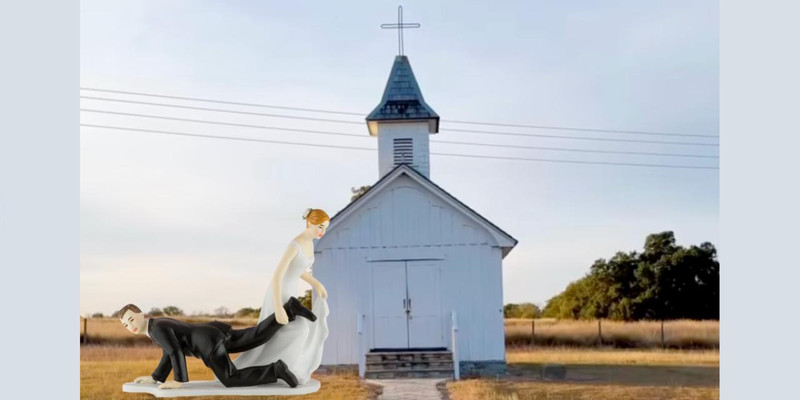

We have a problem and the only way out of it is through. For most, that will look ugly. For others? Like paradise.
I am, of course, writing on the Marriage Question, posted on the ultraviral tweet a couple of weeks back by Andrew Tate: "What's the benefit of marriage for a man?" He asked.
This is the Internet. There is no such thing as nuance. Responses ranged from the wholesome Brittany Hugoboom, founder of Evie, and her family's story of pure devotion... to the "red-pillers" like Richard Cooper, who answered, "There is none."
Andrew replied, "Bingo."


Here's what's going on: Projection.
We answer the Marriage Question based on our own personal sample size of n=1 experiences. Parents had a bad marriage? Had a bad marriage yourself, plus a worse divorce? And you're a dude? "Bingo."
But if your family provided exemplary husbandly and wifely examples from your get-go, so you only knew to emulate such devotion, commitment, and joy? In the good times and bad? "That's when you see what a marriage is."
So really, the Marriage Question we're all reading into Tate's original post is as follows—and there are two of them:
Marriage Q #1: What's the benefit of my marriage for me?
Marriage Q #2: What's the benefit of marriage in general for men & women in general?
This is key. The first question is easier to answer; it's projection-based. What you've seen is what you'll get. If you've known positive examples of marriage, as I've witnessed over my life in the conservative Christian Midwest, you are generally matrimony-positive. Two souls become one; yet two multiplies into the force of ten. You be all you can be. It is not good for a man to be alone; it is good for a woman to become his help-mate. What we call traditional marriage, this sanctified pair-bonding-for-life, is a practice so ancient it descends to us from prehistory.
This, by the way, is the little talk I gave at my own brother's wedding—how holy matrimony is this wondrous ancient way of officially uniting that unit of man and wife that has already come together. Imagine the first wedding. What language did they speak? What was the officiant? What were the rings like? Were there rings? Sticks? Grasses maybe? Tiny woven reeds? One wonders.
And so, from ancient times, the couple who bore children bore children, who... bore you and then me. And that's how we came to be. Through the stabilizing, civilizing institution of Western marriage.
But that's not the only kind of marriage.
That brings us to the second question: the benefit of marriage in general to men (and women) in general.
"Hell is murky." — Lady Macbeth in Act 5, Scene 1, Macbeth.
In A.D. 2025, marriage is no longer what it once was, or what it was for most of history, both in prerecorded and written form. Biblically speaking, the husband cares for his wife's needs as if they're his own, and the wife respects and obeys her husband. This is Biblical marriage. Perfect polarity. Masculine and feminine. Yin and yang. Heaven meets Earth.
But in general, that's not what marriage is for most of us anymore. Legally speaking, modern state-sanctioned marriage is merely a business contract; it's an asexual threesome—"me, you, and Uncle Sam make three." Every divorcee understands this. In "manosphere" circles online, there's a casual explainer for the division of assets in our post-feminist marital world: "What's hers is hers; what's yours is half hers, too." And then there are children—so much pain and suffering. We needn't get into it all.
Naturally, homosexuality can claim the institution of marriage for itself because no such holy heterosexual institution exists any longer in the United States. If you want to live with someone, pay pretty much half the bills, and jointly buy stuff together—like a house and a car or two—you're de facto business partners in life itself. Who cares what sex or gender you are?
This is the modern state of marriage. And both conservative men and liberal women are complaining about it. It's a crazy cycle; single men wonder, "Where have all the feminine women gone?" The single women ask, "Where are all the masculine men?" And so the men become effeminate, and the women become hashtag boss babes. For in the absence of their polar opposite, their natural counterpart, they adopt as their behaviors that which they seek in another.
Is there any fixing this? There is. But we will need to endure Late-Stage Marriage Equality to get there. And it goes like this:
Some jurisdictions, like New York, have already begun to offer limited legal protections for throuples and other polyamorous relationships, such as recognizing them as families in some contexts, or allowing for more than two domestic partners.
Yeah, some libertarians we know who have "co-wives" are "based." But then imagine three dudes. Four. Or more. "Marriage." Love is love, amirite? Murky. The only way out is through.
To return to men being men and women being women—in the context of preparation for and fulfillment of marital duty, for life—that's what we as a society will endure first. But then? We will demand this sacred, Biblical institution once again.
But this will only come when we are so post-marriage as a society that we are pre-marriage. At that time, we will "discover" this thing called marriage as if for the first time. Our women will protect their purity; our men will prove themselves worthy providers. Families will assist in arranging these relationships aptly, the original "dating app."
What's the benefit of marriage for a man? Right now, marriage gives a man a 50/50 business partner, an investing partner, and a life partner. If you have a good, smart, and sweet partner, you'll succeed in business and in life.
And if not? Then not. That's how it goes. In the future, one to one and a half decades from now, we as a society will be at a loss for what marriage even is. That's when we will find it.
One man. One woman. One God. Pure. Wholesome. Devotion. For life. That's when you'll see what a marriage is.