
This past week, Trump took to the global stage in Davos, letting it be known that the United States will remain strong, independent, and a leader in the world. His Greenland framework reaffirms that promise; the framework, however, has not come without harsh criticism.
But while seething about Trump’s supposed power grab over Europe, critics pass over the strategic importance (and brilliance) of Trump’s bid. In fact, acquiring Greenland is about beating back Communist China’s increasing infiltration into the Arctic.
The CCP has tried to play off the idea that their expansion into the Arctic is a step towards global hegemony. And unfortunately, all too many Americans will buy this narrative–that the CCP is harmless, posing no threat to America.
And who can blame them? For years, Americans have been relentlessly fed a false narrative—pushed by policymakers, corporations, and the legacy media—that integrating Communist China into the global economy would lead to China’s political liberalization. We have been told that a prosperous China would be good for America and good for the world. Instead, the Communist Party has used its newfound wealth to construct a formidable military machine that now rivals the United States.
Perhaps the hardest part to stomach about the CCP’s rise is the untold story of how elites in our very own government enabled it.
In fact, there are three key figures who defined this early U.S.–CCP collaboration that haunts us still, known in China as the “Three Johns”: John Carter Vincent, John Paton Davies Jr., and John Stewart Service, all U.S. State Department Officials with direct influence on American China policy. These three men played critical roles in advancing the Communist cause and CCP ascendancy that Trump is fighting today.
John Carter Vincent was the highest-ranking among them—a seasoned China hand who served as director of the Office of Far Eastern Affairs in the State Department. A strong advocate for U.S.–CCP cooperation, Vincent accompanied Vice President Henry Wallace to China and pressured Chiang Kai-shek to approve the Dixie Mission, the first U.S. endeavor aimed at establishing relations with the CCP. Vincent argued that engaging with the Communists would strengthen the war effort and yield strategic intelligence. He believed China’s size and nationalist sentiment would prevent it from becoming a Soviet satellite. His views laid the groundwork for the later Marshall Mission, often seen as the continuation of the Dixie Mission.
John Paton Davies Jr., the first to propose formal contact with the Communists, was born in China to missionary parents with a deep knowledge of Chinese society and culture. It was he who coined the term “Dixie Mission,” likening Yan’an to the American South during the Civil War—a rebellious region.
Though Davies himself wasn’t a formal mission member, he visited China several times, meeting Mao and other top CCP leaders. He came away impressed, describing Mao’s leadership as cohesive, pragmatic, and firmly in control. In reports like “How Red Are the Chinese Communists?” Davies concluded that the CCP was not very red and was open to cooperation with the United States. He even suggested the United States cut off aid to the Nationalists unless they stopped opposing the Communists.
John Stewart Service, the third John, had the greatest influence. Like Davies, he was also born in China—in my hometown of Chengdu, to be exact—to missionary parents. He was fluent in Mandarin and three dialects and deeply immersed in Chinese culture—traits that uniquely positioned him to assess the CCP. During more than three months in China as a member of the first Dixie Mission group, he held multiple meetings with Mao Zedong and Zhou Enlai, including an eight-hour marathon talk with Mao—the longest meeting any U.S. official had with the CCP leader at the time.
Service sent back glowing reports. In “General Impression of the Chinese Communist Leaders,” he described them as physically vigorous, pragmatic, democratic, honest, incorruptible, and lacking in vengeance, italicizing these traits for emphasis. He claimed they resembled Americans more than Russians or traditional Chinese. He recommended direct U.S. military support for the CCP, even proposing the establishment of a U.S. consulate in Yan’an. Through Service, Mao sent messages to President Roosevelt, urging balanced support and even proposing a visit to the U.S.
The Three Johns were not alone. Their pro-CCP advocacy reflected a broader trend in the State Department, where CCP figures were increasingly referred to as “so-called Communists” and their territories as the “so-called Communist area.”
These three men’s analyses and recommendations directly influenced policy decisions in Washington, making a consequential impact that lasts to this day.
This lingering permissiveness towards China not only in the State Department, but also across American institutions, is one of the most important reasons why Trump’s Greenland bid, as well as his general tough-on-China stance, matters. It matters even more in the face of an enfeebled Europe. If the actions and influence of the “Three Johns” teach us anything, it is that how Trump and other government officials handle China in 2026 will have consequences decades down the road.
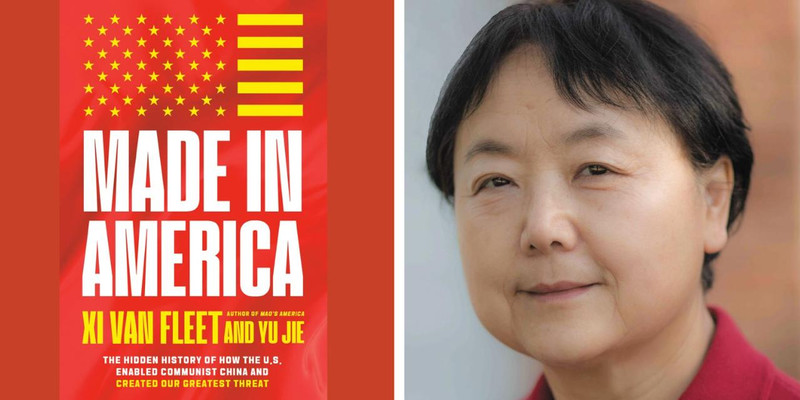
Xi Van Fleet is author of the forthcoming book “Made in America: The Hidden History of How the U.S. Enabled Communist China and Created Our Greatest Threat.”