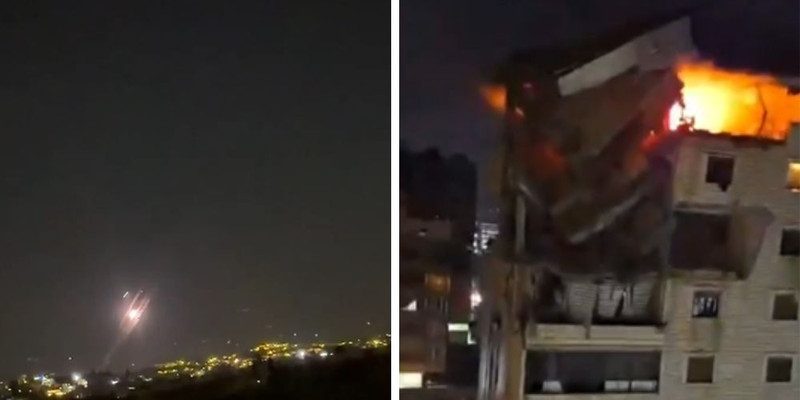

Rockets and drones launched from Lebanon set off air-raid sirens across northern Israel early Monday, as Hezbollah said it had joined Iran’s war against Israel. This triggered Israeli strikes across Lebanon, including in Beirut.
The Times of Israel reported that around 1 am, sirens sounded in Haifa and surrounding areas. According to the Israel Defense Forces, the missiles originated from Lebanon, not Iran. One rocket was intercepted, and at least two others were allowed to fall in open areas. Drone alerts also sounded in the Upper Galilee, where Israeli air defenses shot down at least two suspected drones. According to the IDF, at least three additional rockets launched from Lebanon struck open areas in northern Israel around 3 am. There were no immediate reports of injuries or damage in Israel.
Hezbollah claimed responsibility, saying the attack was in retaliation for the killing of Iranian Supreme Leader Ali Khamenei during the joint Israeli-US assault on Iran on Saturday. The barrage came hours after Hezbollah leader Naim Qassem said the group would confront Israel and the United States over strikes on Iran, despite the Lebanese government’s plea that it remain on the sidelines, as it had during a previous 12-day Israel-Iran war in June 2025.
Monday’s launch was the first time Hezbollah fired at Israel since a US-brokered ceasefire between Israel and Lebanon in November 2024. Hezbollah claimed the attack was a warning for Israel to withdraw from five Israeli-held border posts inside Lebanon, which Israel maintains for security reasons. Israel responded with what it described as the start of a multi-day offensive.
IDF Chief of Staff Lt. Gen. Eyal Zamir said the military had begun an “offensive campaign” against Hezbollah. “We are not just on the defense, now we go on the offense,” Zamir said in remarks released by the military. He said Israel should prepare for “several days” of fighting. The IDF said it struck Hezbollah targets in Beirut and across southern Lebanon. It also hit a vehicle carrying two operatives from Hezbollah’s Radwan Force near Kfar Dajjal. Israel also issued evacuation warnings for civilians in dozens of villages in southern Lebanon.
Lebanese security sources said multiple areas of Dahiyeh, a Hezbollah stronghold, were hit. Residents fled on foot and by car, clogging roads after strikes began around 2:40 am. Lebanese media reported that schools and shelters were being opened to accommodate people displaced from the south and east.
Lebanese Prime Minister Nawaf Salam condemned the rocket launches without naming Hezbollah directly. “Regardless of who is behind it, the rocket fire from southern Lebanon is an irresponsible and suspicious act that endangers Lebanon’s security and safety and gives Israel pretexts to continue its attacks,” Salam wrote on X. He said Lebanon would take action to prosecute those responsible and prevent the country from being “dragged into new adventures.”
Lebanon’s leaders have sought to reinforce state authority over Hezbollah since the 2024 ceasefire. President Joseph Aoun reiterated Sunday that “the decision of war and peace rests solely with the Lebanese state.” Arabic media reported Salam called an emergency cabinet meeting for 8 am local time after the overnight launches.
The Times of Israel reported that around 1 am, sirens sounded in Haifa and surrounding areas. According to the Israel Defense Forces, the missiles originated from Lebanon, not Iran. One rocket was intercepted, and at least two others were allowed to fall in open areas. Drone alerts also sounded in the Upper Galilee, where Israeli air defenses shot down at least two suspected drones. According to the IDF, at least three additional rockets launched from Lebanon struck open areas in northern Israel around 3 am. There were no immediate reports of injuries or damage in Israel.
Hezbollah claimed responsibility, saying the attack was in retaliation for the killing of Iranian Supreme Leader Ali Khamenei during the joint Israeli-US assault on Iran on Saturday. The barrage came hours after Hezbollah leader Naim Qassem said the group would confront Israel and the United States over strikes on Iran, despite the Lebanese government’s plea that it remain on the sidelines, as it had during a previous 12-day Israel-Iran war in June 2025.
Monday’s launch was the first time Hezbollah fired at Israel since a US-brokered ceasefire between Israel and Lebanon in November 2024. Hezbollah claimed the attack was a warning for Israel to withdraw from five Israeli-held border posts inside Lebanon, which Israel maintains for security reasons. Israel responded with what it described as the start of a multi-day offensive.
IDF Chief of Staff Lt. Gen. Eyal Zamir said the military had begun an “offensive campaign” against Hezbollah. “We are not just on the defense, now we go on the offense,” Zamir said in remarks released by the military. He said Israel should prepare for “several days” of fighting. The IDF said it struck Hezbollah targets in Beirut and across southern Lebanon. It also hit a vehicle carrying two operatives from Hezbollah’s Radwan Force near Kfar Dajjal. Israel also issued evacuation warnings for civilians in dozens of villages in southern Lebanon.
Lebanese security sources said multiple areas of Dahiyeh, a Hezbollah stronghold, were hit. Residents fled on foot and by car, clogging roads after strikes began around 2:40 am. Lebanese media reported that schools and shelters were being opened to accommodate people displaced from the south and east.
Lebanese Prime Minister Nawaf Salam condemned the rocket launches without naming Hezbollah directly. “Regardless of who is behind it, the rocket fire from southern Lebanon is an irresponsible and suspicious act that endangers Lebanon’s security and safety and gives Israel pretexts to continue its attacks,” Salam wrote on X. He said Lebanon would take action to prosecute those responsible and prevent the country from being “dragged into new adventures.”
Lebanon’s leaders have sought to reinforce state authority over Hezbollah since the 2024 ceasefire. President Joseph Aoun reiterated Sunday that “the decision of war and peace rests solely with the Lebanese state.” Arabic media reported Salam called an emergency cabinet meeting for 8 am local time after the overnight launches.