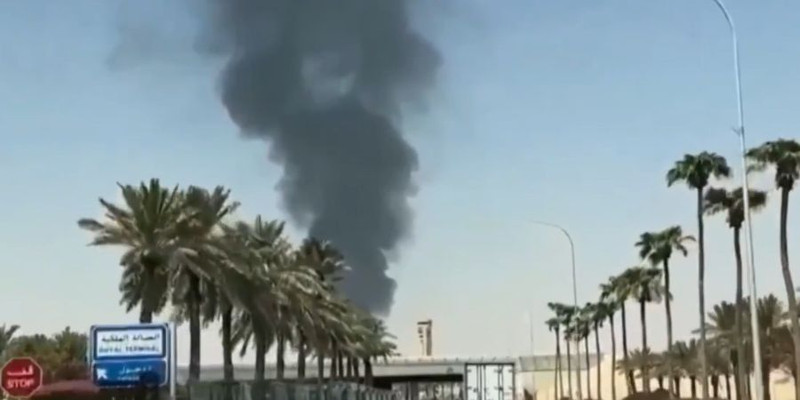

Air strikes hit Riyadh's main airport, which set an oil depot ablaze in Saudi Arabia on Saturday, and large plumes of smoke were seen after explosions were heard, with Saudi Arabia sending overnight warnings of attacks as the Iran-backed Houthi terrorist group has been escalating attacks against the country.
Huge pillars of smoke were seen at the airport after the strikes took place.
Overnight, Riyadh residents got notifications about a “hostile aerial threat" that could take place. According to The New York Times, this is the first time since July that alerts were made in Riyadh since July.
The strikes come after Iraq-based militants, as well as the Houthis, took out a pipeline in Saudi Arabia and other oil infrastructure that fed the supply of oil in Europe. According to the Associated Press, the groups have been coordinating the attacks. The East-West pipeline has been temporarily shut down, which is responsible for around 5 percent of all the world's oil supply.
Although there has not been word from the White House about US involvement in the situation as of yet, President Donald Trump is at Camp David this weekend. This comes amid a broader conflict between Iran and the US, which has also bled over at times to involve US allies in the region.
Human Events Daily host Jack Posobiec speculated that Trump could be reviewing strike packages at Camp David. He also commented that this is taking place as Xi Jinping is going to be coming to the US this upcoming week and that “everyone has to look at this with the lens of BRICS coming into confrontation with the West.”
The bombing of the pipeline by the Houthis, much like Iran's interference with shipping in the Strait of Hormuz, has both sent prices on petroleum products up. US oil commodities in the stock market have also increased, indicating that traders believe Europe and other nations will depend more heavily on American-produced oil as a result of the attacks. Saudi Arabia announced earlier this week that there will be no crude shipments into Europe as a result of the attack that took out the pipeline.
Although the world may turn more to US oil, the price of the product is likely to increase as a result, something that could impact the odds that Republicans maintain control of Congress in the midterm elections.
Huge pillars of smoke were seen at the airport after the strikes took place.
Overnight, Riyadh residents got notifications about a “hostile aerial threat" that could take place. According to The New York Times, this is the first time since July that alerts were made in Riyadh since July.
The strikes come after Iraq-based militants, as well as the Houthis, took out a pipeline in Saudi Arabia and other oil infrastructure that fed the supply of oil in Europe. According to the Associated Press, the groups have been coordinating the attacks. The East-West pipeline has been temporarily shut down, which is responsible for around 5 percent of all the world's oil supply.
Although there has not been word from the White House about US involvement in the situation as of yet, President Donald Trump is at Camp David this weekend. This comes amid a broader conflict between Iran and the US, which has also bled over at times to involve US allies in the region.
Human Events Daily host Jack Posobiec speculated that Trump could be reviewing strike packages at Camp David. He also commented that this is taking place as Xi Jinping is going to be coming to the US this upcoming week and that “everyone has to look at this with the lens of BRICS coming into confrontation with the West.”
The bombing of the pipeline by the Houthis, much like Iran's interference with shipping in the Strait of Hormuz, has both sent prices on petroleum products up. US oil commodities in the stock market have also increased, indicating that traders believe Europe and other nations will depend more heavily on American-produced oil as a result of the attacks. Saudi Arabia announced earlier this week that there will be no crude shipments into Europe as a result of the attack that took out the pipeline.
Although the world may turn more to US oil, the price of the product is likely to increase as a result, something that could impact the odds that Republicans maintain control of Congress in the midterm elections.