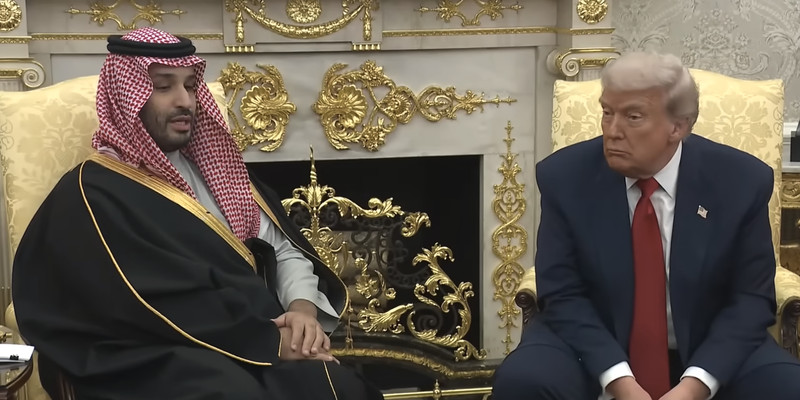

President Donald Trump has signed off on a nuclear cooperation agreement with Saudi Arabia that could pave the way for the kingdom to enrich uranium on its own soil, US officials confirmed Wednesday.
The agreement, which is expected to be announced formally later Wednesday before being sent to Congress, would remain in place until 2056 and could involve tens of billions of dollars, officials said. The Wall Street Journal first reported on the deal.
Under the agreement, American companies would be involved in building a uranium enrichment facility in Saudi Arabia after the two countries complete a joint feasibility study. US officials said American oversight would be used to help ensure the program is not diverted toward military purposes.
Saudi Arabia views Iran as its main regional rival, with Crown Prince Mohammed bin Salman previously saying the kingdom would seek nuclear weapons if Tehran developed them. Former Israeli Prime Minister Naftali Bennett predictably slammed the agreement, warning that allowing Saudi Arabia to enrich uranium could create new risks. “Allowing uranium enrichment on Saudi soil could trigger a regional nuclear arms race and lead to a highly dangerous loss of control. No one can truly predict what the Middle East will look like in 10 or 20 years, which is why the region needs fewer centrifuges—not more,” he said in a statement, according ot the New York Post.
The Trump administration has pushed back against concerns that the agreement could contribute to nuclear proliferation in the Middle East.
Secretary of State Marco Rubio told reporters traveling with him in the Philippines that ”the US is not going to reach any agreement with any country in the world that leads to the risk of proliferation.” The Biden administration had also held talks with Saudi Arabia over a potential nuclear agreement, but those negotiations included a condition that Riyadh normalize relations with Israel. The discussions ended after the Oct. 7, 2023 attacks.
The agreement, which is expected to be announced formally later Wednesday before being sent to Congress, would remain in place until 2056 and could involve tens of billions of dollars, officials said. The Wall Street Journal first reported on the deal.
Under the agreement, American companies would be involved in building a uranium enrichment facility in Saudi Arabia after the two countries complete a joint feasibility study. US officials said American oversight would be used to help ensure the program is not diverted toward military purposes.
Saudi Arabia views Iran as its main regional rival, with Crown Prince Mohammed bin Salman previously saying the kingdom would seek nuclear weapons if Tehran developed them. Former Israeli Prime Minister Naftali Bennett predictably slammed the agreement, warning that allowing Saudi Arabia to enrich uranium could create new risks. “Allowing uranium enrichment on Saudi soil could trigger a regional nuclear arms race and lead to a highly dangerous loss of control. No one can truly predict what the Middle East will look like in 10 or 20 years, which is why the region needs fewer centrifuges—not more,” he said in a statement, according ot the New York Post.
The Trump administration has pushed back against concerns that the agreement could contribute to nuclear proliferation in the Middle East.
Secretary of State Marco Rubio told reporters traveling with him in the Philippines that ”the US is not going to reach any agreement with any country in the world that leads to the risk of proliferation.” The Biden administration had also held talks with Saudi Arabia over a potential nuclear agreement, but those negotiations included a condition that Riyadh normalize relations with Israel. The discussions ended after the Oct. 7, 2023 attacks.