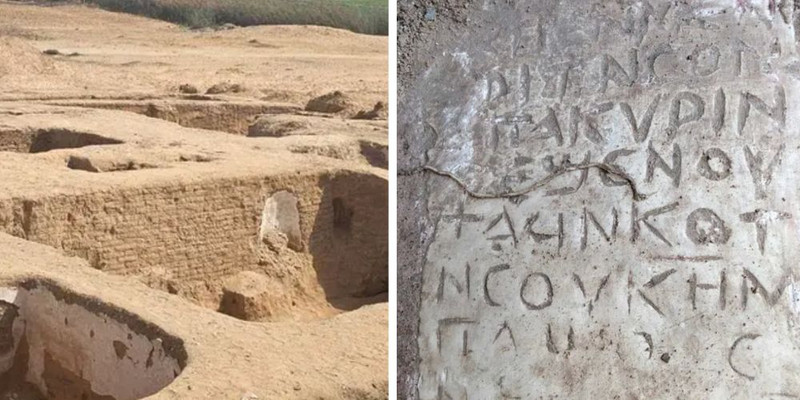

Archaeologists in Egypt have uncovered the remains of a Christian monastic site dating back to the fifth century, including preserved artwork and a Greek inscription.
In a statement released on March 23, the Egyptian Ministry of Tourism and Antiquities announced the discovery of a building in the Qallaya area in Beheira Governorate. The structure is believed to have served as a guesthouse for visitors and represents part of the early development of Coptic i Christianity monasticism.
The building contains 13 rooms that were likely used for "hospitality and teaching… in addition to service facilities such as a kitchen and storage areas,” according to the statement. Images from the site show that many structural elements remain intact, including walls and architectural features in relatively good condition.
Researchers also discovered paintings at the site and a Greek inscription believed to be part of a tombstone reading, "Abba Kir, son of Shenouda.” Also among the findings were a complete marble column and numerous pottery shards, some decorated with Coptic letters and others left undecorated.
"Excavations also revealed several architectural elements added to the building during later historical phases, reflecting the evolution of its use over successive periods," the statement read.
Officials added that the discovery highlights “the development of ascetic, simple monastic architecture, showing a functional progression from individual cells to semi-communal housing.”
The discovery adds to the number of early Christian structures found in Egypt. In recent months, archaeologists have uncovered another Christian structure in Al-Duwair, as well as two churches dating back roughly 1,500 years and an ancient mural depicting Jesus in Kharga Oasis.