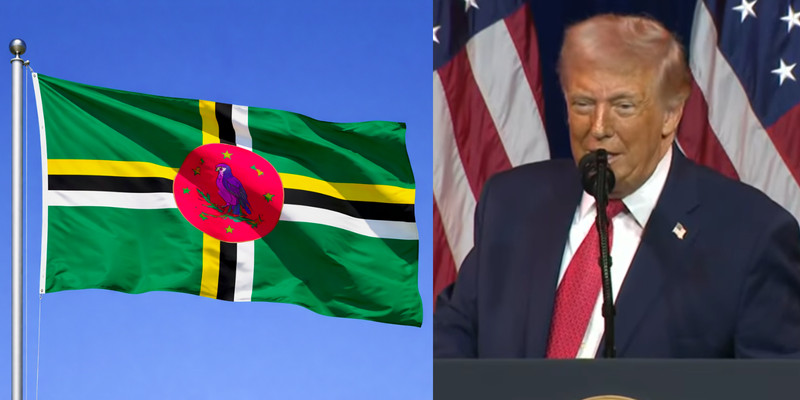

The United States has reached a preliminary agreement with the small island nation of Dominica that could allow asylum seekers arriving at the US border to be transferred to the Caribbean nation, according to reporting by Associated Press.
Dominican Prime Minister Roosevelt Skerrit confirmed the arrangement, calling it “one of the primary areas of collaboration” between Washington and Roseau following recent US visa restrictions imposed on Dominican nationals. The partial restrictions were announced by the White House on December 16 and are set to take effect January 1, 2026.
Skerrit said discussions with US officials have been taking place since the visa announcement but did not specify how many asylum seekers could be sent to Dominica or when transfers might start. He said talks have included what he described as “careful deliberations of the need to avoid receiving violent individuals or individuals who will compromise the security of Dominica.”
Dominica’s government has continued to publicly press US officials over the travel restrictions, stating it “continues its engagement with the United States Embassy in Bridgetown and the State Department in Washington … in an effort to reverse a decision announced by the White House.” The government also clarified that Dominican nationals who already hold valid US visas, including tourist, business, and student visas, “can travel to the U.S. and its territories as is customary.”
According to the Associated Press, the agreement with Dominica is similar to arrangements the US has pursued with countries such as Belize and Paraguay.
Details remain limited. The proposal has drawn criticism from the island’s political opposition. Thomson Fontaine, leader of the country’s main opposition party, said the government has failed to provide basic information to the public.
“The prime minister still has not told the Dominican public what exactly he has agreed to,” Fontaine told AP. He cited unanswered questions about how many people could be transferred, where they would be housed, and how they would be supported once on the island.
Dominica has a population of roughly 72,000 people, and Fontaine said the lack of transparency has raised concerns about whether the country has the resources to take in asylum seekers. He warned that without clear planning, the agreement could strain housing, healthcare, and public services.
No timeline has been announced for when transfers might begin or how the arrangement would be implemented.
Dominican Prime Minister Roosevelt Skerrit confirmed the arrangement, calling it “one of the primary areas of collaboration” between Washington and Roseau following recent US visa restrictions imposed on Dominican nationals. The partial restrictions were announced by the White House on December 16 and are set to take effect January 1, 2026.
Skerrit said discussions with US officials have been taking place since the visa announcement but did not specify how many asylum seekers could be sent to Dominica or when transfers might start. He said talks have included what he described as “careful deliberations of the need to avoid receiving violent individuals or individuals who will compromise the security of Dominica.”
Dominica’s government has continued to publicly press US officials over the travel restrictions, stating it “continues its engagement with the United States Embassy in Bridgetown and the State Department in Washington … in an effort to reverse a decision announced by the White House.” The government also clarified that Dominican nationals who already hold valid US visas, including tourist, business, and student visas, “can travel to the U.S. and its territories as is customary.”
According to the Associated Press, the agreement with Dominica is similar to arrangements the US has pursued with countries such as Belize and Paraguay.
Details remain limited. The proposal has drawn criticism from the island’s political opposition. Thomson Fontaine, leader of the country’s main opposition party, said the government has failed to provide basic information to the public.
“The prime minister still has not told the Dominican public what exactly he has agreed to,” Fontaine told AP. He cited unanswered questions about how many people could be transferred, where they would be housed, and how they would be supported once on the island.
Dominica has a population of roughly 72,000 people, and Fontaine said the lack of transparency has raised concerns about whether the country has the resources to take in asylum seekers. He warned that without clear planning, the agreement could strain housing, healthcare, and public services.
No timeline has been announced for when transfers might begin or how the arrangement would be implemented.