
For centuries, Islamic expansion moved in one direction. From Arabia into the Levant. From the Levant into North Africa. From North Africa into Spain. From Anatolia into the Balkans. The pattern was consistent. Advance, conquer, subordinate, absorb.
Then something changed. Christendom began to resist. These are the moments when Europe refused submission and paid the price to preserve its civilization. These were not wars of aggression.
They were wars of survival. And without them, the West as we know it would not exist. To better paint the picture, let’s step into the story of one of the greatest heroes of the West, Charles the Hammer changed history at the Battle of Tours.
Charles the Hammer
By the early eighth century, the world was on the brink of forgetting Christendom. Islamic armies had already done what no enemy before them had achieved. They had shattered the ancient Christian heartlands of the Middle East and North Africa. Alexandria, Carthage,
Jerusalem, Antioch. All had fallen. Churches had become mosques. Crosses had been torn down, spit upon, and countless had been raped on the altars of churches. The descendants of the apostles lived as subjects beneath Islamic rule or had vanished altogether. Then the tide crossed into Europe.
From the ruins of Roman Hispania, Muslim armies pushed northward through the Pyrenees, plundering cities, burning churches, and enslaving captives as they went. These were not wandering raiders. They were veterans of conquest, hardened by decades of jihad, confident that victory itself was proof of divine favor. Islamic chroniclers spoke openly of Europe as the next land to be subdued, its people destined either for conversion, submission, or death.
The Franks were not prepared. Western Europe at the time was fractured, politically weak, and spiritually worn. There was no unified empire, no standing army capable of matching the experienced forces pouring out of Iberia. Monasteries stood defenseless. Villages lay exposed. The old Roman world was gone, and the new Christian one was still fragile.
But one man stood in the breach. Charles Martel was not a king. He wore no crown and claimed no throne. He was the Mayor of the Palace of the Frankish realm, a soldier forged in constant warfare against rival tribes and internal rebellion.
He understood something that many did not. This was not a border skirmish. This was not a raid for plunder. This was an invasion. And all of Christendom was the target.
If the Frankish steel cracked here, the Western world would be defenseless against the massive horde. They were outnumbered three men to one. The Muslim force advancing north was led by Abdul Rahman al Ghafiqi, a seasoned commander who had already crushed resistance across southern Gaul.
His army carried the spoils of countless conquered cities. Their confidence was unshaken. They had never been decisively defeated. They expected the Franks to break like the rest.
Martel chose the ground carefully, drawing the enemy north into wooded hills near Tours, where cavalry charges would be blunted, and discipline would matter more than speed. Where his frankish shields and steel could work.
For days, the two armies faced each other in tense stillness—cold winds cut through the camps. No battle cry was raised. No charge was sounded. Then the clash came.
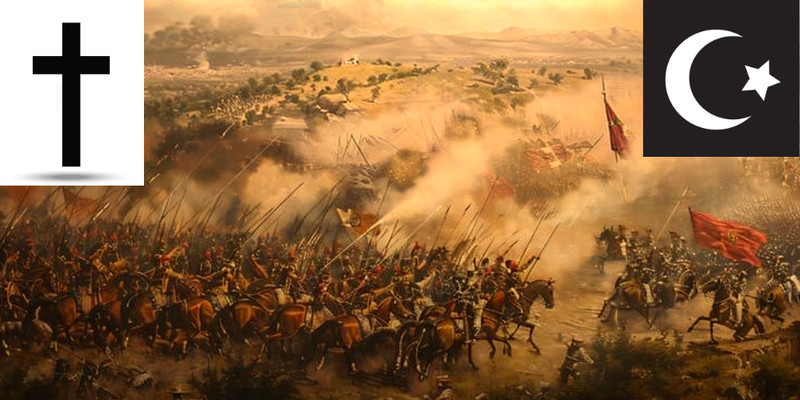
The Muslim cavalry hurled itself against the Frankish line, again and again. Horses slammed into shields. Steel rang against steel. But the Franks did not break. They stood locked together in a solid wall of men, foot soldiers trained by Martel to hold their ground at all costs.
They fought not as mercenaries but as defenders of their homes, their churches, their families. Of all of Christendom. Hour after hour, the assaults failed. As the battle dragged on, confusion spread through the Muslim ranks. A rumor swept the field that their camp was being looted, that the immense wealth taken from earlier conquests was in danger. Discipline cracked. Units broke formation. And at that moment, Abdul Rahman was struck down.
The commander of the jihad lay dead on Frankish soil. By nightfall, the Muslim army withdrew. Under the cover of darkness, they retreated south, abandoning their dead and wounded. When dawn came, the Franks advanced cautiously, expecting renewed attack.
It never came. The Islamic army was gone. For the first time since the rise of Islam, a major invading force had been stopped cold in open battle. Not negotiated with. Not bought off. Not absorbed. Stopped.
The significance of this moment is not merely a military event, but a civilizational one. Had Martel fallen, there was nothing between the Islamic armies and the heart of Europe. No force capable of resistance. No second line of defense. Tours was not just a battlefield. It was a line beyond which Christendom would not pass. Islamic chroniclers themselves acknowledged the gravity of the defeat. They called the battlefield the Pavement of the Martyrs. They did not speak of it as a minor loss. They understood what had happened.
The momentum had been broken. Charles Martel did not pursue glory. He did not declare holy war. He returned to governing, consolidating defenses, and strengthening the realm. But his stand bought time.
Time for Europe to recover. Time for Christian civilization to take root, to grow institutions, to build culture, to remember who it was. That time changed everything. Within a generation, Charlemagne, Martel’s grandson, would be crowned Holy Roman Emperor. Monasteries would preserve learning. Cathedrals would rise. Europe would become recognizably Christian.
All of it depended on that stand. This is why modern attempts to minimize Tours ring hollow. This was not an accident. It was not inevitable. It was the result of courage, discipline, and a refusal to submit. The Franks did not win because they were superior in number or technology. They won because they believed their civilization was worth defending. The brutality that had erased half of Christendom was turned back, not by appeasement or dialogue, but by resistance. The West survived because one generation stood its ground. And it would have to do so again. Tours were not the end of the conflict. It was the beginning of resistance.
The Islamic advance did not disappear. It shifted. It regrouped. It pressed elsewhere, at sea and in the east, against Byzantium and the Mediterranean world. Christendom would face the same threat again at Lepanto, at Vienna, and across centuries of pressure that followed. To understand how Europe held, we must now follow the story forward, from forests of Gaul to the open waters of the Mediterranean, where the fate of Christian civilization would once again hang in the balance.
The Long Struggle in Spain
Resistance did not mean immediate victory. In Spain, Islamic rule endured for centuries. Christians survived as minorities under dhimmi status while slowly reclaiming territory in a process known as the Reconquista.
This was not a single war but a centuries-long effort marked by reversals, alliances, and endurance. The fall of Granada in 1492 marked the end of Islamic political rule in Iberia. For nearly eight hundred years, Christians fought not to expand but to reclaim land lost through earlier conquest. Memory matters here. The Reconquista was not born of hatred but of survival.
The Eastern Front, Byzantium, and the Balkans
While Western Europe resisted piecemeal, Eastern Christendom faced relentless pressure. The Byzantine Empire stood as a Christian bulwark against Islamic expansion for centuries. It lost territory gradually but managed to preserve Constantinople through repeated sieges.
In 1453, the city fell to the Ottoman Turks. The conquest of Constantinople was not merely a strategic move. It was civilizational. The great Christian capital became Istanbul. Churches became mosques. Hagia Sophia was transformed from a cathedral to a symbol of Islamic triumph. From there, Ottoman armies pressed into the Balkans and Central Europe.
Lepanto- The Sea Turns Red
By the sixteenth century, Islamic power dominated the Mediterranean. The Ottoman navy raided European coasts and controlled key sea lanes. Christian shipping was vulnerable. Slavery flourished. In 1571, a Christian coalition known as the Holy League confronted the Ottoman fleet at the
Against expectations, the Ottomans were decisively defeated. Lepanto shattered the myth of Ottoman naval invincibility. Tens of thousands of Christian galley enslaved people were freed. The psychological impact across Europe was immense. Lepanto did not end Islamic power, but it proved that resistance was possible.
Vienna The Line Held
The final great test came at Vienna. In 1683, Ottoman forces laid siege to the city, seeking to break into the heart of Europe. If Vienna fell, much of Central Europe would lie open to invasion. A coalition of Christian forces led by Polish King Jan Sobieski arrived just in time.
The siege was broken. Ottoman expansion into Europe was decisively halted. After Vienna, the Ottomans slowly retreated. Europe advanced. This was not a conquest for its own sake. It was containment after centuries of pressure.
The Crusades in Context
No discussion of Christian resistance can avoid the Crusades. They are often caricatured as unprovoked aggression. The historical record tells a different story. By the time of the First Crusade in 1096, Islamic armies had conquered vast Christian territories, desecrated holy sites, and restricted Christian pilgrimage. The Crusades were launched in response to appeals from Eastern Christians and were framed as defensive wars to protect the faithful and recover sacred ground.
The Crusades were imperfect. Violence occurred. But they were not the beginning of the conflict. They were a response to hundreds of years of Muslim aggression and the capture of half of Christendom. What united these moments was not technology alone. Historian Victor Davis Hanson argues that Western armies fought not merely as subjects but as citizens bound by shared moral and civic identity.
Christian Europe was fighting back for the Cross, the Savior who died for them. Fighting back against the aggression of a relentless onslaught of rape, murder, and enslavement. Resistance worked because it was rooted in faith. Modern Western culture is deeply uncomfortable with this history.
It disrupts narratives of Western guilt and Islamic victimhood. It suggests that survival sometimes requires force. It affirms that borders and beliefs matter. So it was flattened. The result is a civilization that remembers its sins but forgets its defenses.
The West today is told that resistance is immoral. Defending borders is hateful. That asserting Christian identity is dangerous. History says otherwise. Without Tours, Lepanto, and Vienna, there would be no Europe to critique itself today. Christendom did not survive because it was perfect. It survived because it fought.
In the next installment, we turn inward. We examine how the West lost its nerve, not through defeat but through forgetting. How secularism, relativism, and guilt hollowed out a civilization that once knew what it was and why it mattered. That story explains how Islam advances today without armies.