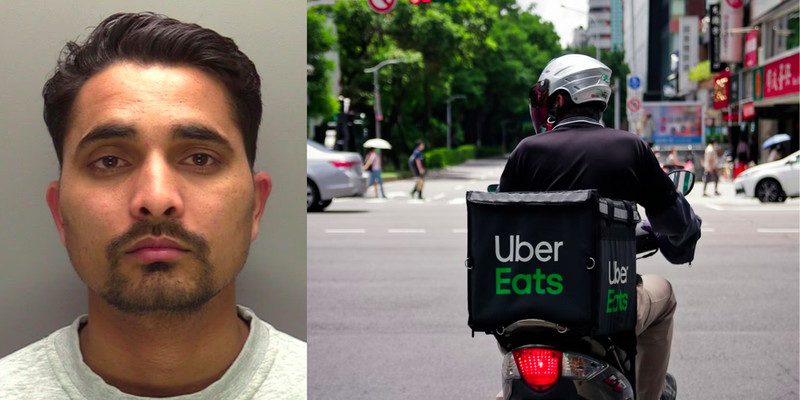

A UK food delivery driver who returned to a customer’s home hours after dropping off an order has been jailed for rape, with the court handing down a sentence of more than three years after a guilty plea.
Jitendrakumar Prajapati, 47, was sentenced at Lincoln Crown Court to five years in custody, reduced to 44 months, according to the Daily Mail. The sentence also includes 18 months for sexual assault to run concurrently, along with a deportation order.
The court heard Prajapati, an Indian national working as an Uber Eats driver, first visited the victim’s home in Boston, Lincolnshire, around midday on January 14. During the delivery, he spoke with the woman and asked for her contact details, saying he wanted help with a visa application.
They exchanged phone numbers and social media details. Later that same day, at around 5 pm, he returned to the address. After initially engaging in conversation, Prajapati raped the woman inside her home. Following the attack, he sent her a message stating, “Hey I am sorry”.
Further messages were exchanged in which the victim accused him of rape. His replies were described in court as apologetic, with requests that she not report the incident. The victim contacted police shortly after the assault, leading to Prajapati’s arrest by 9 that evening.
He had also changed his WhatsApp settings to enable disappearing messages after 24 hours.
He was initially arrested on suspicion of rape and non-fatal strangulation. The latter charge was later dropped in court.
Detective Constable Jessica McKiernan said: “Bringing this offender to justice was made possible by the extraordinary courage shown by the victim in coming forward at the earliest opportunity.
“Her trust in us allowed our officers to begin swift and focused inquiries, which led to the suspect being located within hours.
“Her bravery has been vital in ensuring he is now held to account. We hope this outcome offers her some sense of reassurance as she moves forward on her own terms.”
Lincolnshire Police said: “Lincolnshire Police are not responsible for sentencing. Policing is part of a broader criminal justice system, and its role is to protect the public, enforce the law, investigate crimes, gather evidence, arrest and detain suspected offenders.
“Police forces help build case files for court and may be involved in the court process, but do not lead on the sentences convicted offenders receive, where they go to prison, or when they are released.”
Jitendrakumar Prajapati, 47, was sentenced at Lincoln Crown Court to five years in custody, reduced to 44 months, according to the Daily Mail. The sentence also includes 18 months for sexual assault to run concurrently, along with a deportation order.
The court heard Prajapati, an Indian national working as an Uber Eats driver, first visited the victim’s home in Boston, Lincolnshire, around midday on January 14. During the delivery, he spoke with the woman and asked for her contact details, saying he wanted help with a visa application.
They exchanged phone numbers and social media details. Later that same day, at around 5 pm, he returned to the address. After initially engaging in conversation, Prajapati raped the woman inside her home. Following the attack, he sent her a message stating, “Hey I am sorry”.
Further messages were exchanged in which the victim accused him of rape. His replies were described in court as apologetic, with requests that she not report the incident. The victim contacted police shortly after the assault, leading to Prajapati’s arrest by 9 that evening.
He had also changed his WhatsApp settings to enable disappearing messages after 24 hours.
He was initially arrested on suspicion of rape and non-fatal strangulation. The latter charge was later dropped in court.
Detective Constable Jessica McKiernan said: “Bringing this offender to justice was made possible by the extraordinary courage shown by the victim in coming forward at the earliest opportunity.
“Her trust in us allowed our officers to begin swift and focused inquiries, which led to the suspect being located within hours.
“Her bravery has been vital in ensuring he is now held to account. We hope this outcome offers her some sense of reassurance as she moves forward on her own terms.”
Lincolnshire Police said: “Lincolnshire Police are not responsible for sentencing. Policing is part of a broader criminal justice system, and its role is to protect the public, enforce the law, investigate crimes, gather evidence, arrest and detain suspected offenders.
“Police forces help build case files for court and may be involved in the court process, but do not lead on the sentences convicted offenders receive, where they go to prison, or when they are released.”