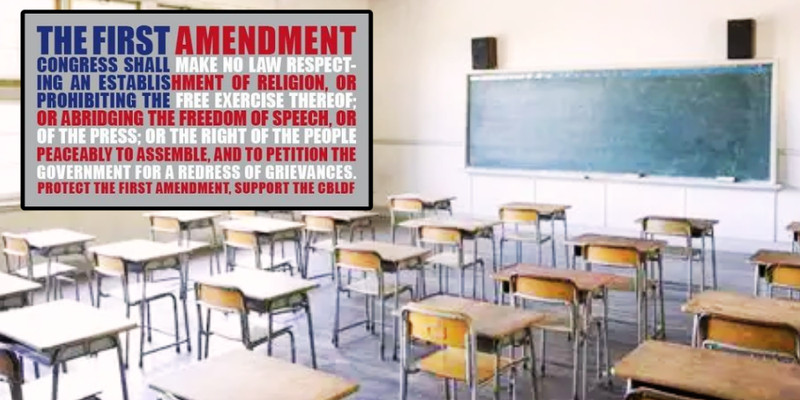
Across the United States, public school districts bear an immense responsibility: preparing young people to be informed, thoughtful citizens in a democracy founded on fundamental rights. Yet, school districts across the nation consistently violate one of our most cherished constitutional rights—that of free speech.
School districts betray legal obligations and undermine education by censoring public opinion, politicizing school facilities, and policing student speech.
First, consider the case of the Konocti Unified School District in California. On October 21, 2025, Konocti district officials blocked members of the public from viewing or posting on the district's social media pages.
These modern marketplaces of ideas are vital conduits for information, discussion, and feedback between public schools and the communities they serve. When government agencies use social media to share news or solicit participation, these digital spaces are public forums entitled to the strongest First Amendment protections. However, Konocti and other school districts in San Jacinto, CA, and Pulaski County, KY, paid these protections no mind.
Konocti's decision to initially censor and even block users altogether echoes authoritarian instincts rather than democratic ones.
The ability to question and interact with public school districts is not a privilege held only by government cheerleaders. It is a core constitutional right held by all. School districts cannot restrict public expression simply because it is inconvenient or unwelcome.
When they do so, it violates the First Amendment, full stop. And when Konocti violated the First Amendment, it was the Liberty Justice Center's threat of litigation that prompted them to take accountability and restore access to those they had blocked. Sadly, censorship is just one way school districts violate the First Amendment.
While some districts muzzle public voices, others amplify partisanship. Just this past August in Portsmouth, VA, the Portsmouth Public School Division handed over its taxpayer-funded facilities and resources to a gubernatorial campaign for a political rally.
The school district's chief operating officer led this unconstitutional initiative. District emails show teachers were encouraged to attend by the school principal. School maintenance staff were instructed to manicure the school grounds and arrive early to assist with setting up the rally.
Staff meetings previously scheduled were moved to make room for the rally. Yet the campaign paid nothing for the use of the Portsmouth public school and services.
By providing facilities and services to a political campaign free of charge, the Portsmouth Public School Division violated the First Amendment. The school district forced Portsmouth taxpayers to subsidize speech in the form of political advocacy.
By spending its taxpayer resources on political rallies instead of education, Portsmouth school district leadership also abdicated its responsibility to students. When schools become political actors rather than arbiters of impartial education, they abandon their duty to foster open, pluralistic environments where all viewpoints are welcome. They also risk eroding trust within the community by compelling unwanted political speech instead of educating students.
Compelled speech by school districts exists beyond the political arena. Speech is compelled in the nation's classrooms. For example, Ohio's Olentangy Local School District forced students to utter speech contrary to their own sincerely held beliefs. A district policy forced students to address others using "preferred pronouns" or face potential punishment.
While schools should strive to ensure all students are treated respectfully, the First Amendment prohibits the government from punishing people for speaking impolitely. The Sixth Circuit Court of Appeals recently agreed, holding that the school district may not punish students for failing to use specific pronouns.
The Olentangy policy highlights a broader issue: rather than fostering critical thinking, dialogue, and mutual understanding, some districts resort to mandates and punishments. These policies breed resentment. And it suppresses authentic engagement with difficult issues – the exact speech the First Amendment promotes.
A healthy educational climate should foster civil discourse on issues that matter deeply to students, rather than suppressing it through top-down directives.
Each of these examples – Konocti's censorship, Portsmouth's political rally, and Olentangy's compelled pronouns – reveals a common and unsettling reality. Too many school districts view Constitutional rights as subordinate to impulses of control or ideology.
By violating the First Amendment, school districts teach their students precisely the wrong lessons about citizenship, compromise, and civil liberty. Instead of nurturing open discourse, intellectual curiosity, or tolerance for diverse views from all perspectives, these districts model exclusion, partisanship, and coercion.
The urgent focus in schools today should be on empowering students to think independently, debate constructively, and engage as active members of a pluralistic society. By silencing critics, pushing politics, or imposing beliefs, school districts fail in their central mission of education. And the means of failure are unconstitutional.
Brendan Philbin is senior counsel at the Liberty Justice Center, a nonprofit, nonpartisan, public-interest litigation law firm.