War is a way of life for America. A nation whose existence requires the maintenance of global domination, whose raison d'etre is to be the leader of the free world, and makes integral decisions with an eye toward world supremacy. The trick is to be so big you can't be f*cked with but not so fat that you're lazy, content, and vulnerable.
A nation without an ethnic or racial identity, without an ancient history, a nation founded on that amorphous concept of shared values, civility, and individual freedom is a country that must preserve more than a people or a scrap of land but an ethos. That's where we've been failing under the onslaught of immigration, of opening arms to all the world's downtrodden, and in trying to spread the democracy we hold dear to nations who do not want it.
We've squandered fortunes and lives for nothing but the pride of knowing we tried to do the right thing, and failed.
The United States is the last bastion of western civilization and the military industrial complex sees its vocation as making sure the United States is a solitary and indisputable super power. A thing of value must be protected. This is the mission of the Secretary of War, who I followed out to California as he visited weapons factories and gave a speech at the Reagan National Defense Forum.
In his annual address, George Washington said in 1793 "if we desire to secure peace… it must be known that we are at all times ready for war." This was reiterated by the man who gave the intro to Hegseth's speech, calling the concept of "peace through strength” "an American tradition."
Being big, mighty, strong, and yes, exceptional are foundational components of Americanness. These are key aspects of what it means to be us. As a kid, I swam in waters of an American culture that was steadfast and sure that we were the best nation to ever exist. Better than England at the height of her colonial powers, better than Rome even as they built roads across Europe. We were America, the strong, the proud, the free.
Anyone who dared tread on us, we figured, would f*ck around and find out. That all changed post-9/11 when we somehow victim blamed ourselves and begged the terrorists to love us. We promised to change, to become more globally compliant, we taught our kids these new lessons of self-hatred and self-harm and now we wonder why they all think we suck.
The Trump administration may not always be entirely to my taste, but I far prefer—no, I love—the boasting prideful exuberance in American greatness. That greatness doesn't necessarily have to prove out, but it's got to be felt in every American heart and soul. It's baked into who we are. It's why you can recognize an American in any port overseas: we're not ashamed of our brash bigness. We relish it.
Sec War Pete Hegseth did not take questions at any of the stops, though press set up under the wing on flight after flight to photograph his stepping off the plane and stepping back on again. As the new press corps, the one willing to sign the Pentagon's mandated pledge not to publish leaked documents, we were under pressure to not suck and not to suck up to the administration.
As the 30-ish hour trip wore on, we started to believe that perhaps the Pentagon invited us in just to watch, like some cuckold in a corner chair, as the War Dept went about their business with America and we had no say and no special insight. We'd all been mocked by The New York Times, The Washington Post, and others who walked out en masse following the pledge demand. We all knew it was an unwarranted mocking, borne out of frustration and bias, but still, we wanted access, the kind those in the legacy press had been denied under this administration.
The new press pool gathered at Joint Base Andrews in the early morning snow at 6 am on Friday morning. I'd started my drive at 4 am on the icy, beautiful country roads of West Virginia to make it on time and by the time I arrived I was only slightly more awake than I was when I'd started out.
Joint Base Andrews is its own city, not that I could see much of it in the blustery darkness. Our bags were sniffed. Our sleepy morning selves were briefed by military and the military adjacent who are used to this kind of private, taxpayer-funded travel. They handed out a double-sided trifold agenda packed with a to-the-minute itinerary. Then we grabbed a bus to head down the tarmac to the jumbo jet with the big United States of America stenciled on the side, the Doomsday Plane, and waited under the wing to watch the Sec War board the plane.
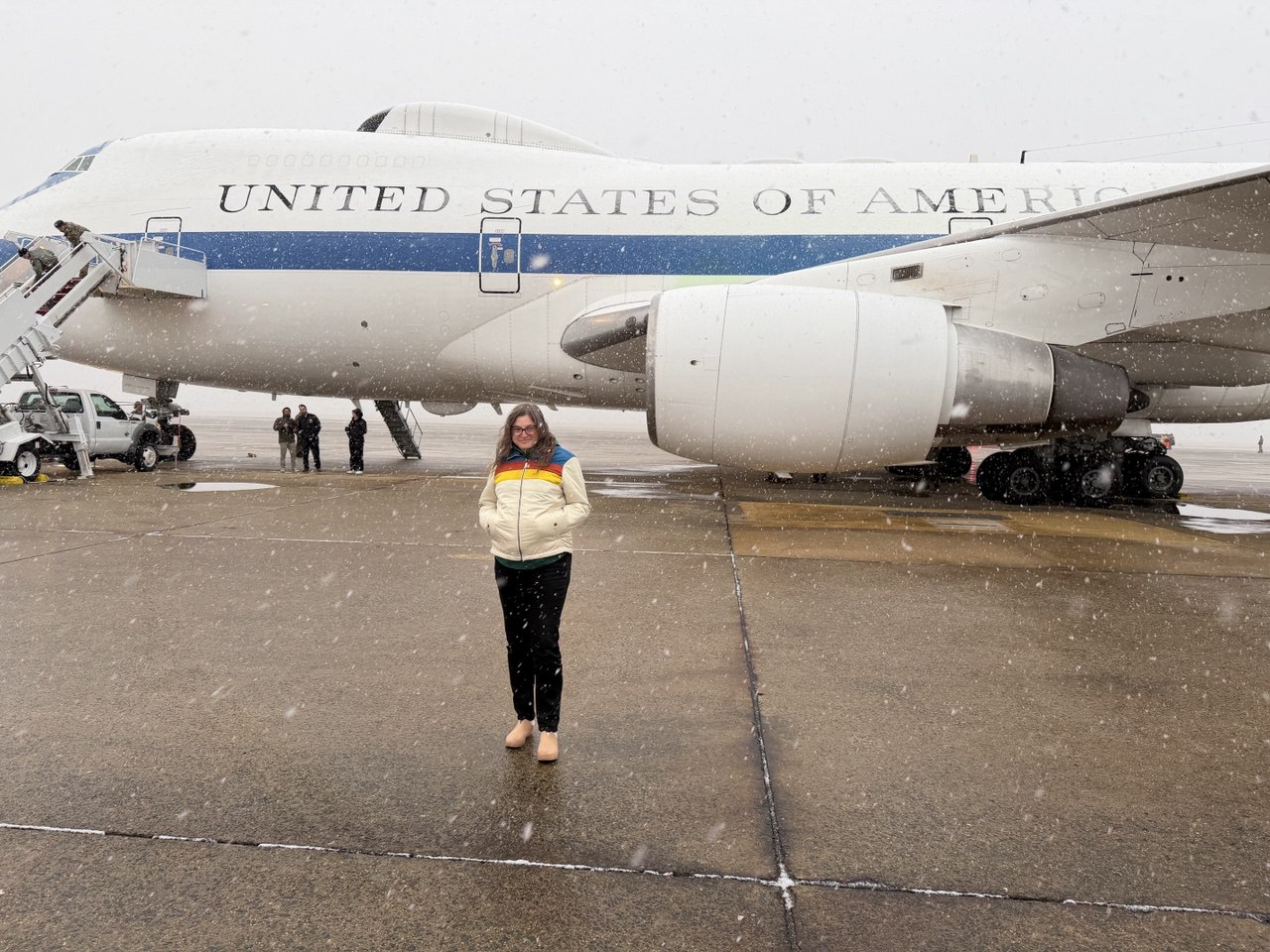
Doomsday Plane
This would become the routine in a day that would see three flights and a press corps that was flying blind. Aside from CBS, who were running pool footage which feeds into TVs across the country, the rest of us were from the reset. The CBS guys looked like veteran war correspondents, battle hardened after a decade of Trump rallies.
The rest of us all took pics of each other in front of the plane because we're noobs and that's what noobs do. It occurred to me that this is part of the impetus behind the great Pentagon press corps reset of 2025: new guys don't know the ropes, don't know what to demand, don't know what they are entitled to, assume in fact, that they are entitled to nothing.
We kept asking anyway. We wanted access to the Sec War, which is itself a reset from the Secretary of Defense posture that admins have had going back nearly a century. The renaming of the agency to the War Dept from the Defense Dept comes under the man who calls himself the "peace president." The idea is to create a military build-up so big and so strong that no nation, rogue state, or terrorist groups will dare mess with the United States.
I checked my agenda. Three flights to make stops at two different defense contractors. Motorcades in between. Rules were listed about how far from the Sec War we were required to stand, language about staying in your "bubble," outside of his "bubble."
Sec War sat up front, using a different, more photogenic set of steps to board the plane than us in the press. Ours were slick, icy, on the other side of the plane, like Upstairs/Downstairs Pentagon jumbo jet edition. We were served a breakfast of a cheese omelette, bacon, a packet of Cholula and a yogurt. It was one of the better meals we got.
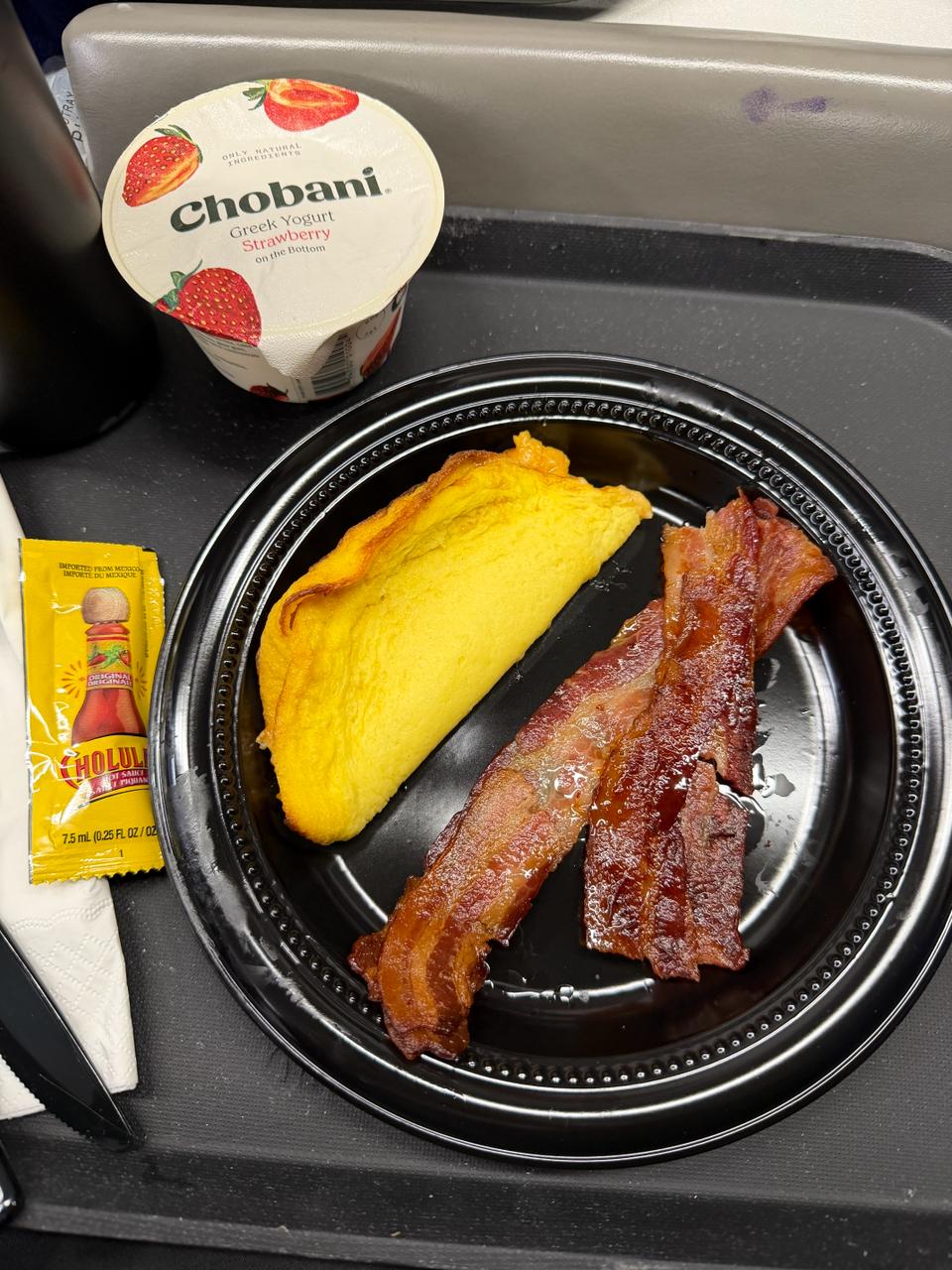
Breakfast on the Doomsday Plane
We touched down in Santa Ana at Port Mugu. Pool set up under the wing to feed the nation's TV stations footage of the Sec War getting off the plane. He took no questions. We were on a tight schedule. A line of six fighter jets stood on the tarmac with the mountains in the distance. At the end of the line were two drones. In a couple years, those numbers will likely be reversed. Especially if the first stop on our weapons tour, Anduril, has anything to say about it.
The sun was a delightful respite from the snow back east as we shot photos of the Sec War in his bubble shaking hands and talking to troops and officials. We all dug around in our bags for our sunglasses and I was grateful to find mine. We watched from a distance, security stationed between us and the bubble.
Sec War examined a Navy drone as a C-17 hummed ominously in the background after having accompanied us across the country. For the old guard this was all old hat but for us new media in the press corps, the experience was all brand new. And we took it seriously as CBS shot footage of the Sec War boarding that C-17 to head out to Long Beach. We rushed aboard as soon as the Sec War was loaded.
The inside of a C-17 is like if you were on a regular plane with all the guts ripped out and ramped up the volume by 1,000. We opened up our boxed lunch of Tex Mex ground beef and rice as a jump-suited Air Force guy with a perfectly trimmed mustache handed out ear plugs. We strapped in and took off for Long Beach and autonomous weapons maker Anduril, headed by Palmer Lucky.
The military industrial complex of the United States of America is so sprawling and vast as to be impossible to quantify. It's part of the tech sector, manufacturing, food service and production, textiles, transportation, logistics. Bases polka dot the nation and we've got troops stationed all over the world.
Hegseth would later preview the national defense strategy in his speech at the Reagan National Defense Forum and that strategy comprises nearly every aspect of American life. "Out with utopian idealism, in with hard-nosed realism," he said. Then listed four goals: defending the US homeland and hemisphere, deterring China through strength and not confrontation, increasing the "burden sharing" between the US and allies, and "super-charging" US defense. This is what he called "flexible realism."
But it would be hours before we got to that. We had munitions factories to tour first. And we hadn’t even checked into our hotel.
The Tex Mex wasn't sitting well with me as the C-17 pilot announced our descent. The landing gear squeaked as it deployed and without windows I had no idea how close we were to the ground until we were upon it.
Pool set up to the side of the wing to film Sec War get off the plane and shake hands with troops and officers in Long Beach before we press sprinted for the last van in the motorcade, piled inside, and shot off down the 405. Our speeding caravan contained the only cars on the road, flanked by motorcycle cops.
From my vantage point in the rear seat of the last van in the motorcade, I could see the final car in our procession: a solitary swerving cop car keeping the vast Los Angeles squadron of public vehicles away from our bubble.
We rolled up to Anduril where snipers stood keeping watch from the rooftops. The building that houses the most forward thinking manufacturer of autonomous, AI-powered weapons in the United States used to be home to the printing press for the Los Angeles Times. That's how far our information culture has fallen: from expanding knowledge to increasing fire power.
Lucky gave us a tour of the lobby while Hegseth went into closed rooms to check out high-tech autonomous secrets. "The thing that all of our products have in common here is that they're powered by Lattice," said Lucky, "which is the AI brain that makes all of our products work. We've got about twice as many people working on Lattice as we do all of our hardware products combined."
Their AI software powers drones, sentry towers, smart helmets, and unmanned submarines. The idea is that eventually, and not too long from now, the software will allow drones and weapons to go radio silent on deployment and take out targets without the benefit of a human kill order.
A new aircraft boasts laser guided bombs, helmets offer a feed from soldiers' vision back to base. These machines will "learn" to pull their own trigger. The thing about autonomy and AI is that when the wrong button is pushed, there's no one to call to set things right.
Lucky wore a Hawaiian shirt, a mullet, shorts, and deck shoes with no socks. He had a tufted goatee in the middle of his chin and talked like a gamer kid hopped up on Pringles and Diet Coke about all the firepower his company was building. Hegseth gave a speech to the whole staff, assembled outside in the warm and welcoming California sun.
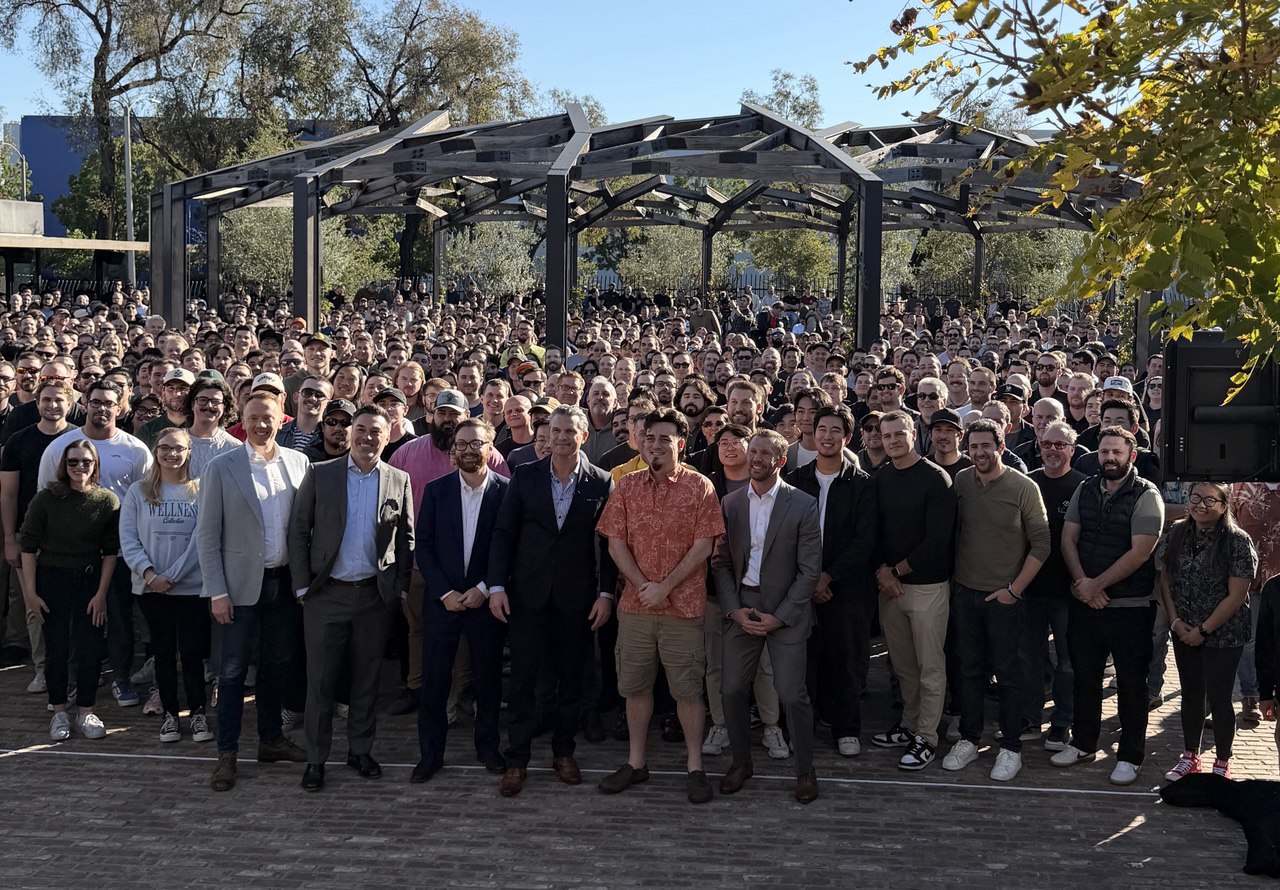
Group pic, Anduril HQ
He praised the company for hiring vets, for hiring Americans, for working outside the normal, slogging acquisition system, for bringing new weapons to the Pentagon that the Pentagon didn't even know it needed. Part of why the US is falling behind is that the war companies have grown fat and lazy on taxpayer money and have seen no real need to innovate their process.
Anduril, and subcontractor Hadrian, are disruptors in the weapons marketplace. Using proprietary software for manufacturing, existing factories and skillsets, these companies aren't waiting for permission. They've learned that you can just do things, and do them American.
It's hard not to look at these weapons makers and see James Bond-style villains, new companies making bank on death, throwing the whole industry into a tizzy just to keep up with them. What's clear, however, is that if Hegseth and the Trump administration get their way it will be an end to American participation in globalism.
Instead of a new world order where America faces off against other nuclear superpowers, the goal is to be so strong and dominant that no other nation can meet us, never mind surpass us, and that would be the deterrent to war. A peace president carries a big stick and is armed with unmanned drones.
This is what Sec War spoke about in his speech to the Reagan National Defense Forum. Until then, we media hung out in the media tent where TVs live streamed the panels from the main stage, inaudible above the din of the espresso machine and local influencers holding meetings. We had breakfast burritos with tater tots embedded in them. They were not delicious.
When our liaison rounded us up like the cats we were, we ran past a panel of the Berlin Wall graffitied with “freedom” and butterflies, through glass doors, around a fountain, down some stairs, and into the main hall. Behind the stage were windows that looked out onto the Santa Susana Mountains. It was absolutely a breathtaking view.
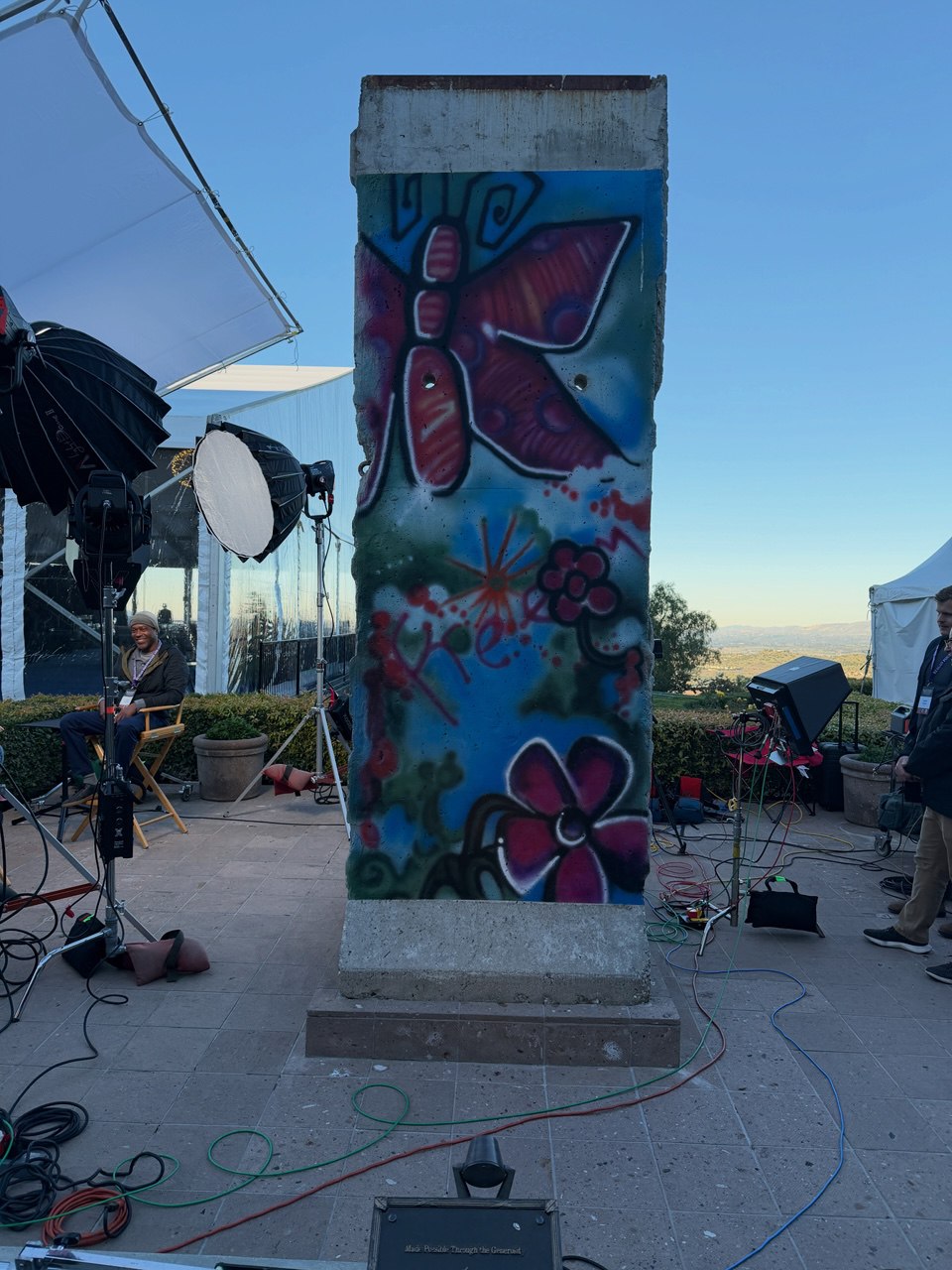
A piece of the Berlin Wall, surrounded by a television set up at the Reagan Library.
Where better to plan the future of war fighting than one of the most beautiful locations on earth?
There's something entirely perverse about holding an elaborate affair in the beautiful hills of Simi Valley, California to discuss how best to wage war. Amid individual mini Le Creuset dutch ovens for the elegant breakfast spread and floral centerpieces to rival a Four Seasons' wedding, generals, military men, defense contractors, AI developers and their aides discussed how best to go about killing mass numbers of people while inflicting the least amount of harm on American troops and civilians.
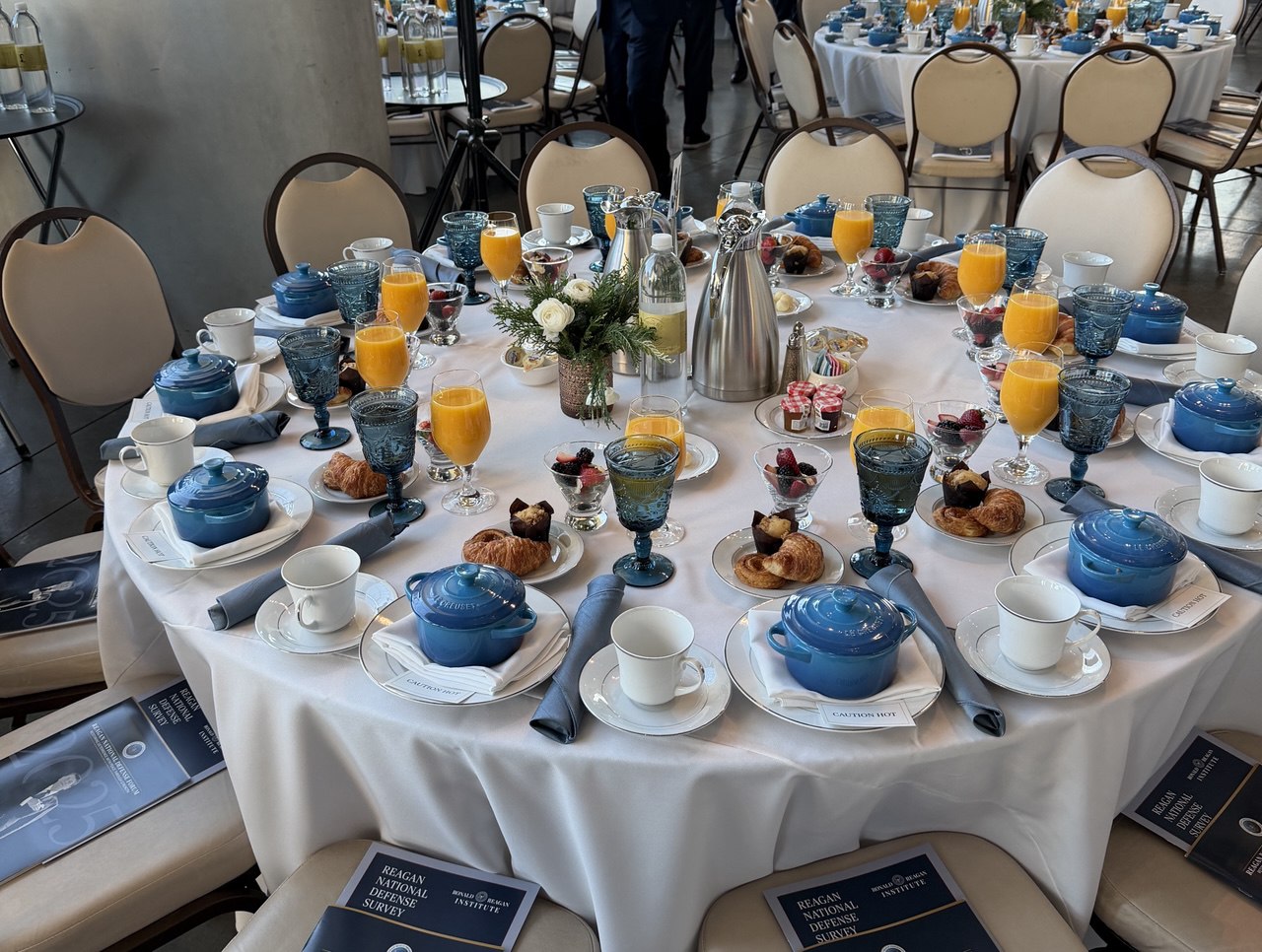
Reagan National Defense Forum breakfast
Or maybe they were just talking about how to prevent other nations from killing our guys. It's also possible that these are exactly the same thing. The elite ruling class and their minions wine, dine, and make deals that will impact the rest of us and they do it surrounded by natural beauty and relics from past conquests.
In his speech to the crowd at Reagan's library, Hegseth said that "narco-terrorists are the Al-Qaeda of our hemisphere, and we are hunting them with the same sophistication and precision that we hunt Al-Qaeda. We are tracking them, we are killing them, and we will keep killing them so long as they are poisoning our civilians with narcotics so lethal that they're tantamount to chemical weapons.
"We're not doing this on our own throughout our hemisphere," he went on, "our allies and partners recognize that these narco terrorists threaten them as well. So we're working together, sometimes overtly, sometimes not, and we'll keep doing so for the sake of a safer, secure and more stable hemisphere for all of us. But make no mistake, where a country cannot or will not do its part, then we at the Department of War will always be ready to take decisive action in this hemisphere. In our hemisphere, there is no safe haven for narco-terrorism."
We attacked the nations that harbored terrorists in other hemispheres, and I wondered if we would be doing that on our own.
Hegseth took no questions from the press. When he was through we all ran for the back of the motorcade, though the prospect of being left behind, forced to spend another few days in sunny, southern California armed with only my sunglasses and an oddly packed backpack while I figured out how to get home didn't seem so bad to me.
One last motorcade and we were back at Port Mugu. One last stand up of Sec War boarding the plane before we dashed up a set of stairs that would, in just a few hours time, be icy and frigid again.
After a round of cold cheeseburgers and an odd selection of chips from the snack basket, we were summoned into Sec War's private chamber. The question time would be off the record, but we took our notes, took it seriously, and got some real answers. Even the non-answers give an indication of where truth lies.
Landing back at Andrews, armed with the feeling that this press corps is the best corps, I realized I'd forgotten where I'd parked. It felt like we'd been gone for weeks. I drove back home over those country roads, missing the way the motorcade could shut down traffic, letting us fly past at top speeds. The question of what it is to be an American is always on my mind and I thought, as I drove home in darkness just as pitch and black as the one I'd left in the day before, that a huge part of being American is loving this nation not in spite of her flaws but also because of them.
This administration is catching hell—all of them do, in one way or another—but the demand by our commander-in-chief to lift up our countrymen, our country, our land, our people is long overdue after decades of cutting ourselves like some depressed, anorexic teen girl. I want a big, strong America, the one were were promised, and I wonder if that promise was always built on a strength so formidable that even our allies are afraid of us.